

By Katy Loren
If you were around in the 1980s like I was, you might be familiar with the old U.S. Army marketing line, “We do more before 9 a.m. than most people do all day.”
Impressive? Absolutely. A little daunting? Also, yes.
While what we’re about to share won’t turn you into an elite military recruit, it can help you start your day feeling more awake, mobile, and ready to move — before you even swing your feet out of bed. And in true My Peak Challenge fashion, it’s not about doing more — it’s about doing what supports your body, right where you are.
These six gentle stretching and mobility movements can be done while you’re still lying down, wiping the sleep from your eyes. They’re designed to get blood flowing through both your upper and lower body, support joint health, and help you ease into your day feeling more energized and less stiff — a small but powerful way to build strength and mobility for life.
Below, you’ll find step-by-step instructions to guide you through the first 10 or so minutes after waking. Think of it as one simple daily habit that supports how you move, feel, and show up — thankfully, no drill sergeant required.
Before starting any of these movements, move your pillow out of the way so you can be flat on your bed.
Related: How Bedtime Yoga Can Transform Your Sleep
Head to Toe Stretch
Reach your arms overhead and straighten your legs. At the same time, stretch your arms as far behind you as you comfortably can while lengthening your legs in the opposite direction. Think about gently elongating your entire body, as if you were trying to grow a little taller.
Exhale and hold the stretch for 15–20 seconds. Then relax completely for a slow count of five as you inhale. Repeat this sequence two to three times, moving with control and without forcing the stretch.
Coach’s Takeaway: This is about gently waking up your nervous system and decompressing the body after sleep — think circulation, not intensity.
Cross-Arm Stretch
The cross-arm stretch is often done standing, but it’s just as effective — and often more relaxing — when performed lying down.
Lie on your back with your body long and comfortable. Extend your left arm straight up toward the ceiling, then slowly lower it across your chest toward your right shoulder, keeping your elbow straight.
Use your right arm to gently cradle the left elbow, applying light pressure to deepen the stretch in your left shoulder. Your right hand will naturally rest near your chin. Breathe steadily as you hold the stretch for 20–30 seconds, staying within a comfortable range.
Release, then switch sides. Alternate arms until each shoulder has been stretched three to four times total, moving slowly and without forcing the movement.
Coach’s Takeaway: Opening the shoulders first thing can help counter tightness from sleeping positions, screen time, and daily stress.
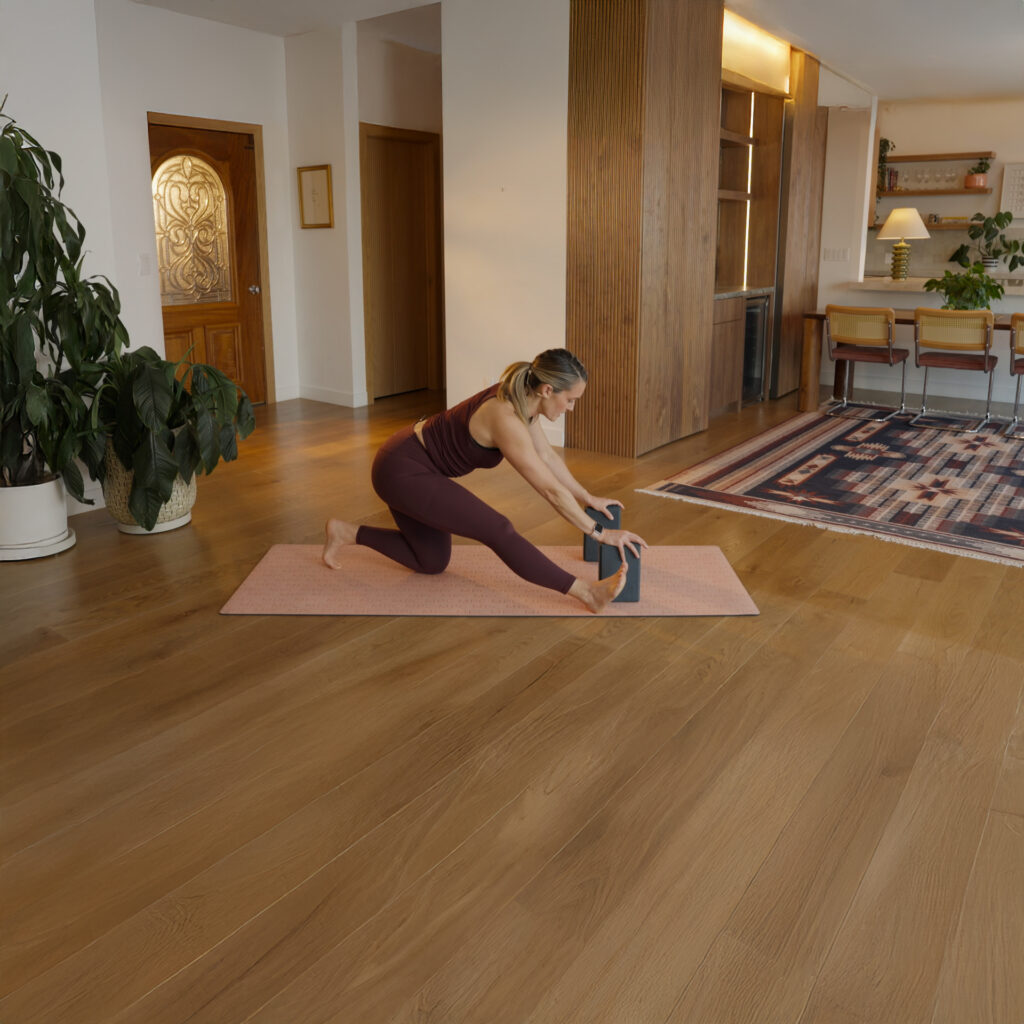
If this routine felt good, there’s more support available. Coach Melissa Mooney’s mobility program helps improve range of motion, joint health, and everyday movement confidence.
Bridge
Lie on your back with your arms resting alongside your body, palms facing down for support. Bend your knees and place your feet flat on the mattress, heels close to your glutes and feet about hip-width apart.
As you inhale, gently press through your feet and lift your hips straight up toward the ceiling. Your weight should be supported through your upper back, with your head and shoulders relaxed against the bed. Think about creating a long line from your knees through your hips and torso, without arching your lower back.
Hold the top position for 10–15 seconds as you slowly exhale, then lower your hips back down with control. Repeat three to four times, moving smoothly and focusing on steady breathing.
Coach’s Takeaway: This movement lightly activates the glutes and hips, which support posture, balance, and everyday strength as we age.
Knee Circles
Lie on your back with your head and shoulders relaxed against the mattress. Extend your arms out at roughly a 45-degree angle from your body, palms down, to help with balance.
Bend your knees to about 90 degrees and lift your feet off the bed, keeping your thighs together and positioned directly above your hips. Your lower back and hips should remain comfortably in contact with the mattress.
From here, slowly draw small circles in the air with your knees, moving clockwise for 30 seconds. The circles should be controlled and moderate in size — roughly the size of your head — without letting your hips lift or shift. Then reverse the direction and circle counterclockwise for another 30 seconds.
Take long, steady breaths throughout, allowing your body to relax as your hips and lower back gently wake up.
Coach’s Takeaway: Slow, controlled hip movement helps lubricate the joints and ease stiffness in the lower back — especially helpful if mornings feel tight.
Windshield Wipers
From the knee circles position, extend your legs straight up toward the ceiling so your torso and lower body form a right angle. Stretch your arms straight out to each side, palms down, to help with balance and stability.
Begin by taking a deep breath in. Then, slowly lower both legs together in an arc toward the left side, moving only as far as you can comfortably go while keeping your opposite hip in contact with the mattress. The goal is control, not range.
Hold the bottom position for a slow count of two. As you exhale, bring your legs back up to the center with intention. Pause briefly at the top, then repeat the movement to the right side.
If straight legs feel challenging, it’s perfectly fine to bend your knees slightly or reduce the range of motion — this movement should feel gentle and controlled, not strained.
Move slowly enough that each lowering phase takes about 30 seconds. Continue alternating sides for three to five minutes, breathing steadily and allowing your body to gently rotate and release tension.
Coach’s Takeaway: Gentle rotation supports spinal mobility and can help your body feel more fluid and connected before the day begins.
Cobra Pose
This final movement is a yoga favorite and a gentle way to open the front of the body after lying on your back.
Roll over onto your stomach and place your hands on the bed alongside your upper torso, palms under your shoulders. Keep your elbows bent and pointing upward. Extend your legs straight behind you, feet a few inches apart, with the tops of your feet resting comfortably on the mattress.
As you inhale, press lightly into your hands and begin to lift your chest, allowing your shoulders to roll back and your collarbones to broaden. Think about lengthening through the front of your body rather than forcing a deep backbend. Your elbows should remain slightly bent, and your hips should stay gently pressed into the bed.
Keep your gaze forward with your chin lifted slightly, avoiding any strain in your neck. If you feel any discomfort in your lower back, reduce the height of the lift or keep your elbows more bent — this movement should feel supportive, not forced.
Hold the stretch for three slow, deep breaths, then lower yourself back down with control. Pause briefly, then repeat one to two more times.
Coach’s Takeaway: A small amount of supported back extension can help offset hours spent sitting and encourage better posture throughout the day.