

By Maureen Farrar
I found out I’d lost power on the pickleball court.
I went up for a ball at the net — the kind of shot I’d hit a hundred times — and went to jump. My legs knew what to do. My brain knew what to do. But my body just… didn’t get there fast enough. I didn’t lack the strength to jump. I lacked the oomph to jump now. By the time I was airborne, the moment had already passed.
That’s power. And it turns out it’s one of the physical qualities that can decline faster than strength as we age — often without us noticing until a moment like mine calls it out.
Strength vs. Power: They’re Not the Same Thing
We talk about strength constantly in the fitness world, and for good reason — it’s foundational, it’s trainable at any age, and it protects our ability to do many of the things we want to do with our bodies. But strength only tells you how much force you can produce. It says nothing about how fast you can produce it.
Power is the ability to produce force quickly. It’s the difference between slowly pressing a heavy weight overhead and explosively jumping off the ground. You can be strong and still be slow to produce force — and it’s that speed component that becomes especially important when life demands an immediate response.
“Power is what saves you when you trip, when you catch yourself, when you climb stairs, when you get out of a low chair,” says Harsha Moole, MD, an internal medicine physician, scientist, and founder of FindMyDirectDoctor.com, who cares for women through perimenopause and menopause. “And power is the one that drops faster with age.”
Research backs that up. Muscle power declines faster than strength as we age, and research suggests it may be more closely tied to physical function. A 2022 systematic review and meta-analysis also found that power training may modestly improve physical function compared with traditional strength training.
Think about the last time you:
- Caught yourself after a stumble
- Popped up quickly off the floor after playing with a kid or grandkid
- Reacted fast enough to grab a railing, countertop, or wobbling glass
- Stepped off a curb and had to catch your balance instantly
- Needed a burst of speed to cross a street or return a serve
Those moments don’t give you much time to think. Your muscles and nervous system have to respond quickly.
And that’s why power isn’t just an athletic quality.
“Getting out of a low seat, walking up a set of stairs, catching her balance easily, and running over a busy road” can all become more challenging as a woman loses power, says Scott Nass, MD, a family medicine physician at SwiftCareMD. He points out that avoiding movements once they become difficult can compound the problem: We move less, giving our bodies fewer opportunities to practice moving quickly.
Related: Why You Should Lift Weights If You’re Over 40
Why Power Fades Faster Than Strength
Here’s the part that surprises many people: You can maintain quite a bit of strength and still lose some of your ability to produce that strength quickly.
Several changes that occur with aging can contribute:
- Fast-twitch fibers are particularly vulnerable. Type II muscle fibers — the fibers we rely on heavily for rapid, forceful movements — tend to atrophy with age.
- The nervous system changes, too. Producing force quickly isn’t just about how much muscle you have. Your brain and nervous system need to recruit those muscles rapidly and coordinate the movement.
- Muscle and connective tissue change with age. Changes in muscle quality, tendons, and other connective tissues can influence how efficiently we’re able to produce and transfer force.
For women, there’s another piece to consider: menopause.
Declining estrogen during perimenopause and menopause is associated with changes in muscle, bone, tendons and connective tissue. But hormones aren’t the whole story.
“Declining estrogen in perimenopause and menopause may contribute to changes in recovery, body composition and muscle quality,” says Nass. “Joint pain, fatigue and disturbed sleep after menopause may also make regular exercise harder, thus impacting muscle performance.”
Moole sees those changes play out in his patients.
“Women tell me they feel fine walking but suddenly cannot step up quickly or push a heavy door,” he says. “That is power leaving before strength.”
That doesn’t mean losing power is inevitable or that menopause suddenly makes us incapable of moving quickly. Activity level, training, nutrition, sleep and overall health all matter — and, importantly, power remains something we can train.
Related: Menopause 101
The Part Nobody Tells Women
Here’s where the fitness industry may have quietly failed women, especially past 40: We’re routinely pointed toward slow, controlled strength work and often steered away from anything explosive. Jumping gets treated as something for athletes or for the young. Quick, forceful movement can sound risky rather than useful.
But power training doesn’t have to mean max-effort box jumps, burpees or sprinting.
It can simply mean practicing the ability to produce force more quickly — at a level appropriate for your body, experience and abilities.
“You do not need heavy weights to train power,” Moole says. “You need to move a light or moderate weight fast.”
That might mean standing quickly from a chair, performing a fast step-up or throwing a light medicine ball with intention. For someone with more training experience, it could include hops, jumps or other plyometric movements.
The point isn’t that every woman should start jumping. It’s that speed is scalable.
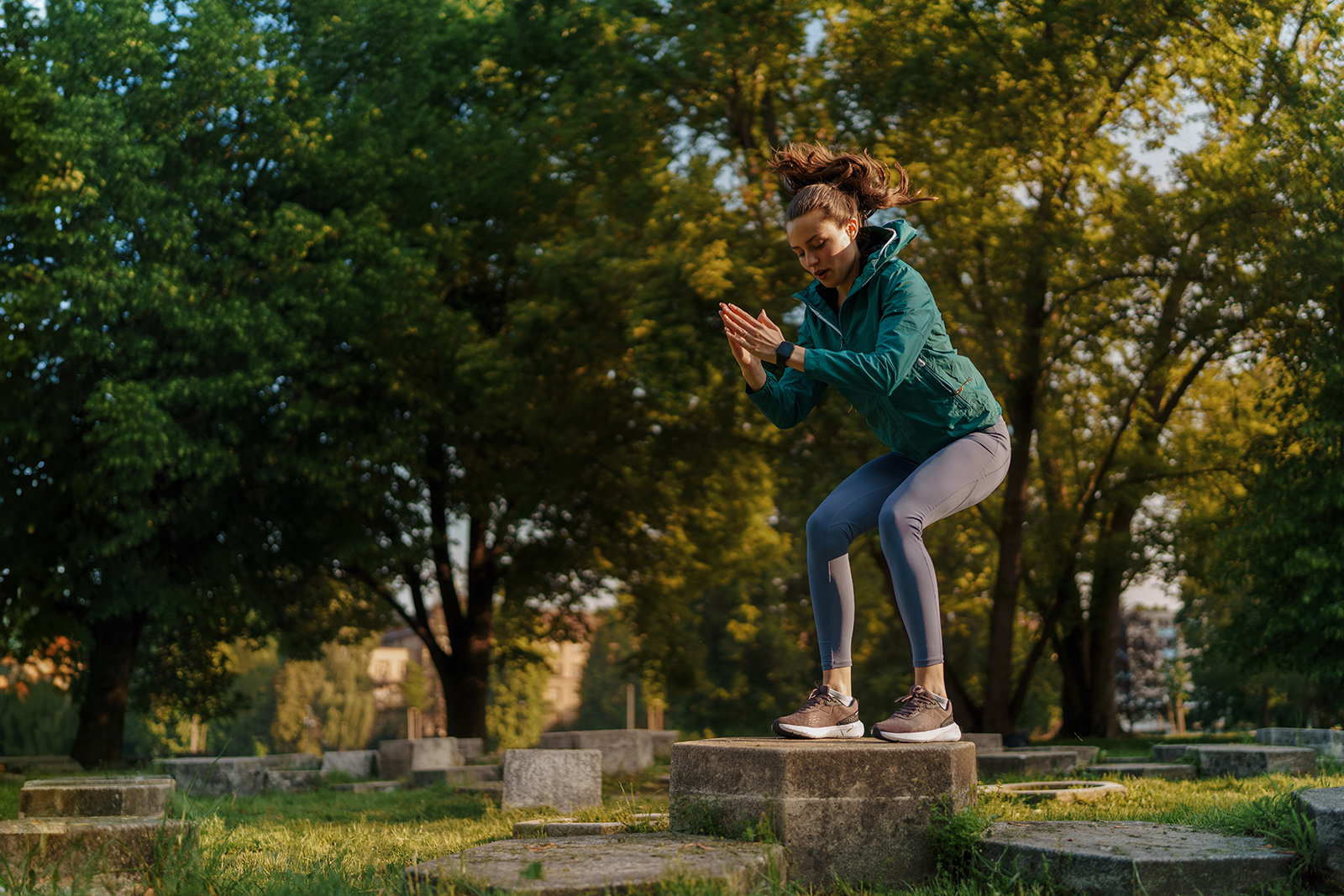
For one person, power training might mean a jump squat. For another, it might mean standing from a chair as quickly as she comfortably can.
This is the same instinct behind why we push strength training so hard at MPC: Being strong and independent isn’t about aesthetics. It’s about being able to trust your body when life doesn’t give you a warm-up.
Power is another layer of that same promise.
Put Your Strength to Work
Strength is the foundation for power. Accelerate combines strength and cardiovascular conditioning to help you build a stronger, fitter, more capable body.
How to Actually Train It — Scaled to You
Here’s the good news: Strength training and power training aren’t necessarily different exercises. Sometimes, the difference is simply how you perform the movement.
In fact, research comparing the two has often used the same resistance exercises for both. The traditional strength-training groups lifted and lowered the weight slowly and under control, while the power-training groups were instructed to perform the lifting portion as quickly as possible, then lower the weight with control.
That means you don’t necessarily need to overhaul your program to begin working on power. In many cases, you can add speed and intent to movements you already know — moving quickly during the effort while maintaining good form and control.
A few examples:
- Sit-to-stands with speed. Instead of slowly rising from a chair, stand up briskly — controlled, but with intent — then lower yourself with control.
- Step-ups with drive. Step onto a box or stair and push through the working leg with purpose rather than casually walking up.
- Medicine ball throws. Chest passes or other appropriate throws allow you to practice producing force quickly without having to jump.
- Quick directional steps. Practice responding and stepping purposefully in different directions while maintaining control.
- Jump progressions, if and when you’re ready. For those with an appropriate strength base, small hops and other progressive plyometric movements can be another way to develop power.
Slow, controlled resistance training still matters enormously. It builds the strength that gives you something to turn into power in the first place. But if every movement you perform is deliberately slow, you aren’t necessarily challenging your body to produce force quickly.
The goal isn’t strength or power. It’s strength and power.
And the rest of the picture matters, too. Adequate nutrition — including enough protein — sleep, recovery and regular activity all support muscle health. Women experiencing significant symptoms during perimenopause or menopause should also talk with their healthcare provider about appropriate treatment options.
Related: You Don’t Have to Jump High to Get Strong
Train for the Life You Want to Keep Living
Power isn’t a vanity metric, and it isn’t just for athletes.
It’s there when you catch yourself after a stumble. When you get up off the floor. When you climb a flight of stairs. When you react to something unexpected.
Or, yes, when you go after a pickleball at the net.
I got my wake-up call on a pickleball court. Yours might come from a curb, a set of stairs or a grandchild running toward you.
But perhaps the most important thing to understand about power is that noticing a change doesn’t mean it’s too late.
“Strength and power respond to training at every age,” says Moole. “The women who do best are the ones who start before a fall, not after.”
So don’t wait for a close call to remind you that moving quickly is a skill worth keeping.
Train your strength. Train your balance. And every now and then, remind your body that it knows how to move with a little oomph, too.