

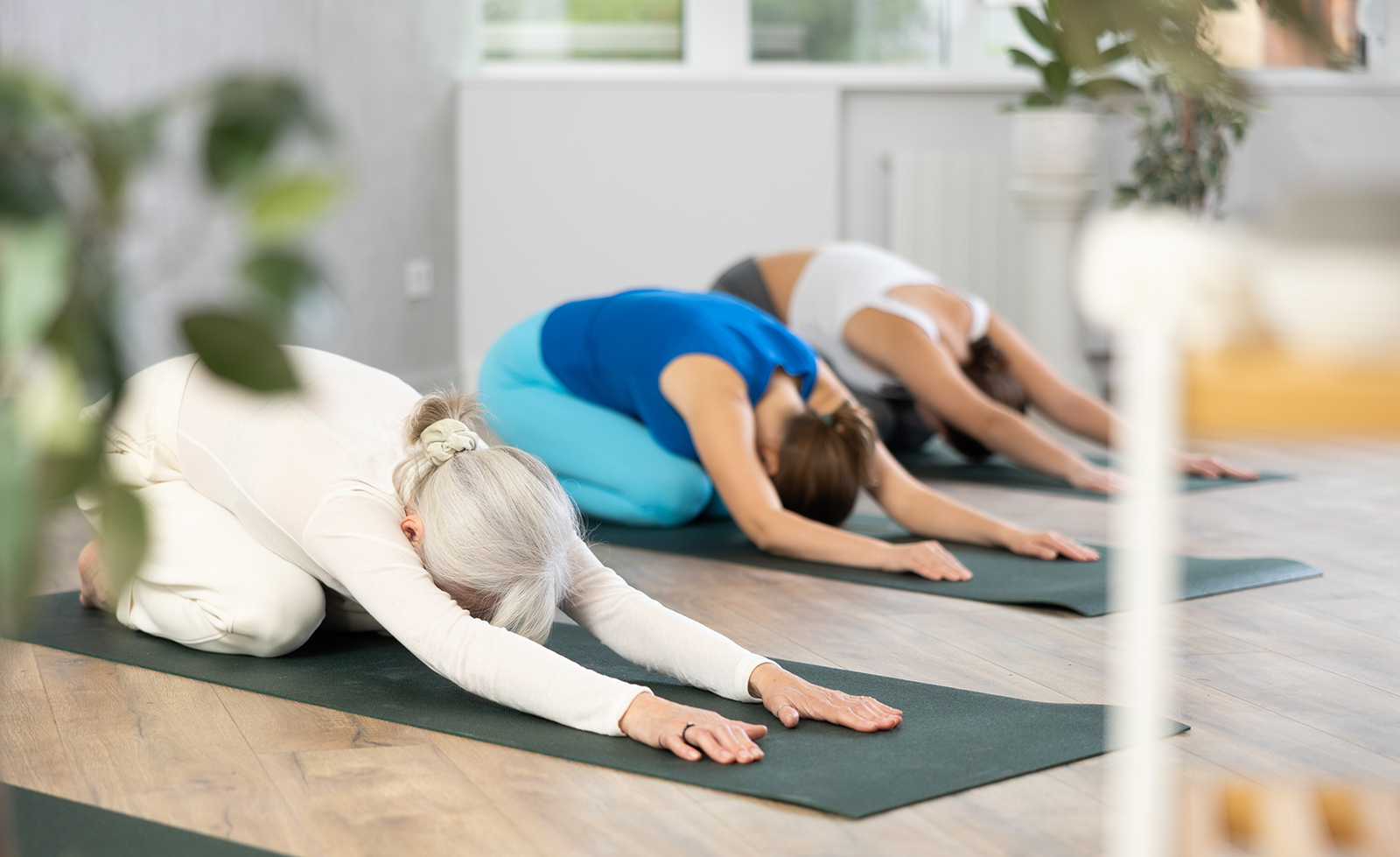
Getting older doesn’t mean doing less. But it may mean doing things differently.
As the years pass, our bodies change. We naturally lose some muscle mass, bone density, balance and mobility, and old injuries or new aches can affect the way we move. That doesn’t mean it’s time to stop challenging yourself. It means becoming more intentional about how you move — and yoga can be a valuable part of that equation.
A consistent yoga practice can help you maintain mobility, build strength, improve balance and stay connected to how your body feels and moves. Just as importantly, yoga is endlessly adaptable. The practice that serves you at 60 doesn’t have to look like the one you did at 30 — and there’s no prize for forcing your body into a pose that no longer feels right.
One of yoga’s oldest principles offers a useful reminder: a pose should be steady and comfortable. Your practice doesn’t have to include a handstand, a deep forward fold or a picture-perfect Warrior pose to “count.” It should support the body you have today and help you keep doing the things you want to do tomorrow.
Here are some of the ways yoga can support you as you age — along with a few things to consider when adapting your practice.
Related: Introduction to Flow
Maintain Strength and Support Your Bones
We naturally lose muscle and bone mass as we get older, making strength-building movement increasingly important. For women, the decline in estrogen associated with menopause can accelerate bone loss and increase the risk of osteopenia and osteoporosis.
Yoga shouldn’t replace resistance training, but it can complement it. Many poses require you to support or move your own body weight, helping strengthen the muscles around your hips, legs, shoulders and core.
Standing poses such as Warrior I and Warrior II challenge the muscles of the lower body, while weight-bearing poses that use the arms can help build upper-body strength.
If you’ve been diagnosed with osteopenia or osteoporosis, however, some movements may need to be modified. Deep forward folds and certain twisting movements can place additional stress on a more fragile spine. Talk with your healthcare provider about movements that are appropriate for you, and consider working with a yoga teacher who has experience adapting practices for osteoporosis.
Keep Your Balance (and Your Confidence)
Balance isn’t just something you need for Tree Pose. It’s involved every time you step off a curb, climb stairs, navigate uneven ground or catch yourself after a stumble.
Balance can decline with age, but it can also be trained.
Yoga gives you frequent opportunities to challenge your stability in a controlled environment. Standing poses strengthen the muscles that help support you, while balancing poses ask your brain, muscles and sensory systems to work together to keep you upright.
And you don’t have to balance unsupported to benefit. Try Tree Pose with one hand on a wall or chair, shorten your stance in a lunge or keep your toes lightly touching the floor.
The goal isn’t to perform the most difficult version of a pose. It’s to challenge your balance safely enough that your body has a reason to adapt.
Protect the Mobility You Have
You may notice that movements that once felt effortless require a little more warm-up as you get older. Muscles and connective tissues can become stiffer over time, and changes in joints can affect range of motion.
Yoga provides a way to regularly move your body through different positions and ranges of motion. A consistent practice can help maintain flexibility and mobility — but more isn’t necessarily better.
You don’t need to touch your toes or push yourself into the deepest possible stretch. In fact, forcing flexibility can sometimes irritate joints and tissues rather than help them.
Think of mobility as maintaining enough freedom of movement to live your life well: reaching overhead, turning to look behind you, getting down to the floor and back up again, or bending comfortably to tie your shoes.
That’s a much more useful goal than achieving a particular pose.
Work With Your Joints, Not Against Them
Arthritis, previous injuries and years of repetitive movement can all affect the way your joints feel.
Yoga can be particularly useful because poses can be modified around what’s comfortable for your body. If your wrists or hands are sensitive, for example, you may be able to practice poses on your forearms, use fists instead of flat palms, practice against a wall or choose positions that don’t require weight-bearing through your hands.
Knee discomfort may mean shortening your stance or adding padding beneath a knee. A chair or wall can provide additional support for standing and balancing poses.
The important distinction is between a movement that feels challenging and one that causes pain. Yoga isn’t a test of how much discomfort you can tolerate. If a pose consistently aggravates a joint, modify it or choose another movement.
Related: The Power of Chair Yoga
Support Your Back (With a Few Caveats)
Back pain becomes increasingly common with age, and yoga may help some people manage it by improving strength, mobility and body awareness.
Building strength through your trunk, hips and legs can give your spine more support, while gentle movement may help reduce the stiffness that often accompanies back pain.
But “back pain” covers a wide range of conditions, and the right movement for one person isn’t necessarily right for another.
For example, someone with spinal stenosis may respond differently to forward bending and backbending than someone with a disc problem. Osteoporosis can introduce another set of considerations.
If you have persistent back pain, spinal stenosis, a herniated or bulging disc, osteoporosis or another diagnosed spinal condition, get individualized guidance rather than assuming a particular yoga pose will help. An experienced instructor can also help you adapt your practice around your condition.
Adapt Around Injuries Rather Than Giving Up Movement
An old knee injury, cranky shoulder or joint replacement doesn’t necessarily mean yoga is off the table.
One of yoga’s strengths is its adaptability. Poses can be done standing, seated, supported by props or even from a chair. Range of motion can be reduced, and movements that aggravate an injury can be skipped entirely.
If you’re recovering from a ligament or tendon injury, however, more stretching isn’t always the answer. Tendons and ligaments need appropriate loading and recovery, and your healthcare or rehabilitation team should guide your return to activity.
Once you’ve been cleared to practice, yoga can provide another way to move your body while rebuilding strength, control and confidence.
The same principle applies after a hip or knee replacement: follow your surgeon’s or physical therapist’s recommendations about which positions and movements are appropriate before returning to your usual practice.
Related: Yoga Nidra: The Guided Meditation That Helps You Rest
Use Yoga to Slow Things Down, Too
Not every benefit of yoga comes from what happens to your muscles.
Breathing, gentle movement and restorative practices can help shift your attention away from the constant demands of the day. And research suggests that a regular yoga practice may also support better sleep, including improvements in overall sleep quality and insomnia symptoms.
That doesn’t mean you need a long practice every night. Consistency appears to matter, and even one or two yoga sessions a week may offer benefits for sleep.
A slower yoga or stretching practice in the evening can also be a useful way to transition out of a busy day. And on days when a harder workout isn’t what your body needs, a gentle practice can keep you moving without adding another demanding training session.
Navigating Menopause? Give Yourself Options
Menopause can affect everything from sleep and mood to energy levels and how comfortable you feel in your body. Yoga isn’t a treatment for menopause, but emerging research suggests a regular practice may help ease some of the psychological and physical symptoms that can accompany the menopause transition.
It can also give you another way to keep moving when your energy or comfort level changes from day to day. Wear layers that are easy to remove if you’re dealing with hot flashes, choose a cooler room and adjust the intensity of your practice to how you’re feeling. On some days, a gentle or restorative practice may be exactly what you need. On others, a stronger flow may feel better.
The goal isn’t to practice the same way every day. It’s to have enough options that you can continue moving in a way that works for you.
Know When You Need More Guidance
Yoga is adaptable, but that doesn’t mean every pose is appropriate for every body or every medical condition.
If you’re managing osteoporosis, cardiovascular disease, blood-pressure concerns, neuropathy, a joint replacement, a spinal condition or another chronic health issue, talk with your healthcare provider about any specific movement restrictions.
If you’re managing an injury or health condition, use the modifications and variations offered throughout your practice, and never feel like you need to push through a movement that doesn’t feel right. Props, shorter ranges of motion and gentler variations can all help you make the practice work for your body.
And remember: modifying a pose isn’t doing a lesser version of yoga. It’s practicing intelligently.
Let Your Practice Grow With You
Perhaps the biggest shift in practicing yoga as you age is letting go of the idea that progress always means doing more.
Sometimes progress is a deeper pose or a stronger hold. But it can also mean maintaining your balance, moving without pain, getting up from the floor more easily or recognizing that your body needs something different today.
Your practice doesn’t have to look the way it did 10 or 20 years ago to still be valuable.
In fact, learning to adapt may be one of the most useful skills yoga teaches us.
Keep building strength. Keep working on your balance. Keep moving through the ranges of motion that feel good. Use props. Modify freely. Rest when you need to.
The goal isn’t to practice like your younger self.
It’s to keep practicing — and keep moving well — for all the years ahead.