
By Katy Loren
Pigeon poses. PNF stretching. Gratitude walks. Helping your body recover from your workouts can include all sorts of different ideas beyond basic rest and nutrition.
Recovery is often the most overlooked part of a successful fitness routine. The truth is, most of us don’t actually know how to slow down and recharge. Maybe it’s our overstuffed to-do lists, a culture that glorifies hustle, or simply the fact that we’ve forgotten how to, well, chill. But giving our muscles—and our minds—a chance to recover is just as important as the workouts themselves.
To help change that, we asked some of our favorite fitness experts to share their go-to recovery techniques—ones that actually work. From Pilates and yoga to meditation and good old-fashioned stretching, these strategies kick-start the body’s natural repair process, easing muscle tension, reducing inflammation, and replenishing energy stores so you can feel and move better.
Option #1: Stretching
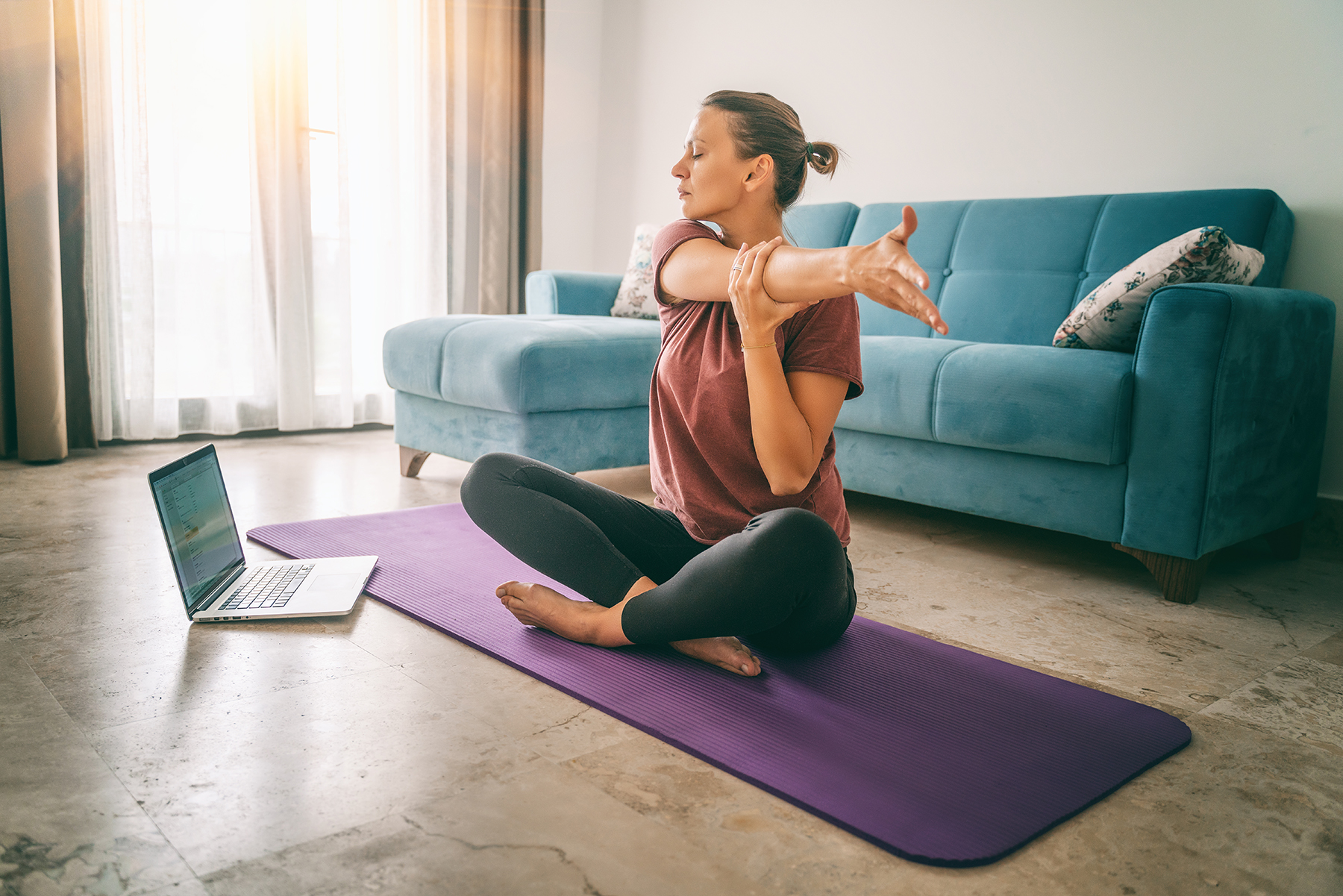
After a challenging training session, incorporating stretching into your routine is a highly beneficial practice that effectively initiates your body’s recovery process.
“Stretching helps your muscles feel better after a workout by loosening them up and creating more blood flow,” says Sara Haley, an ACE-certified personal and group fitness trainer, AFPA pre- and postnatal exercise specialist, and former Reebok Master Trainer based in Los Angeles (see her on Instagram). “Doing it regularly can make you more mobile and flexible, giving you better workouts and quality of life. Mostly, stretching prompts your muscles to relax and heal faster, so you feel less tight.”
Simple enough. However, there are some approaches to keep in mind:
Mix and match. “For a recovery stretch session, it’s a good idea to focus on the parts you just worked — so if you ran, stretch your legs, or if you did upper body, focus on that,” Haley suggests. “But it’s also smart to do a full body stretch to keep everything balanced and prevent stiffness in areas you might not notice. A mix of both is the best way to go.”
Stretching is beneficial for muscle recovery because it improves blood circulation, which delivers oxygen and nutrients to the muscles while removing waste products such as lactic acid, adds Los Angeles personal trainer and former Mr. America Jason Kozma. “This can reduce post-workout soreness and stiffness. Stretching also helps maintain or improve flexibility, preventing tightness and reducing the risk of injury in future workouts.”
Do it right away — and then again tomorrow. “I recommend stretching for 5-10 minutes right after your workout,” Haley says. “The day after, stretch your whole body for 15 to 30 seconds per muscle to reduce soreness and improve flexibility. Stretching right after and the next day speeds recovery and keeps you loose.”
Time it right. While it’s easy to skip stretching when pressed for time, Haley emphasizes that even brief sessions can offer significant benefits. “An ideal recovery-focused stretching session should last about 10 to 15 minutes,” she explains. “This gives you enough time to gently stretch each muscle group, focusing on the areas you hit during your workout.”
The Stretch Run(down)
What’s the best type of stretching for recovery: Static, dynamic, ballistic, or PNF? Kozma breaks down the differences:
Static stretching — holding a stretch for 60 seconds or more — is the best for post-workout recovery, as it relaxes muscles and improves flexibility.
PNF stretching, which uses a pattern of contracting, then relaxing the target muscle — can be highly effective for deeper recovery, but is best done with a partner or proper guidance.
Dynamic stretching is a great warmup before workouts and is useful the next day to promote movement without straining sore muscles.
Ballistic stretching — bouncing into stretches — is not ideal for recovery, as it can raise the risk of strain. It’s advanced technique often used by gymnasts and ballet dancers, but isn’t ideal for rookies or casual exercisers.
“A good recovery stretch routine can include a mix of static and PNF stretching post-workout, with dynamic stretching the next day to promote blood flow,” Kozma says.
Option #2: Pilates
Pilates, which encompasses a series of unique exercises performed on a mat or using a “reformer,” emphasizes the “five essentials:” breathing, scapular stabilization, cervical alignment, engagement of the transversus abdominis, and pelvic mobility. Beyond its role as a standalone workout, Pilates can also serve as a secret weapon in your regular recovery efforts.
“I believe all Pilates lend themselves to aiding muscle and joint recovery,” says Risa Sheppard, a Westwood, California based Master Pilates trainer and creator of The Sheppard Method Pilates.
How? Working the whole body augments healing and reinforces all the joints and muscles. “Think of it like a team,” Sheppard explains. “If one teammate is injured, everyone else has to work harder to compensate for the one who is injured, and cannot operate efficiently. So it is with our body — the more the center, or core muscle groups, are strengthened, the better the body will function. In Pilates, we look at the ‘whole’ as holistic, that one part cannot survive without the other.”
Some important concepts to keep in mind if you decide to try Pilates as a recovery booster:
You can go it alone (eventually). “You can definitely do Pilates exercises on your own, although I always encourage visiting a Pilates studio first if you have never tried it before,” Sheppard says.
Align yourself. “Alignment of the body is the first prerequisite of Pilates,” Sheppard explains. Stand in front of the mirror and mentally run through this three-step checklist:
- Head and neck: Your chin should be lifted from your neck, your eyes focused forward.
- Upper body: Make sure your shoulders are even, slightly shifted back, and pulled away from your ears.
- Hips: They should be like headlights on a car, focusing straight ahead. Check if you can draw a straight line from one point of your hip to the other.
Slow and steady. Pilates movements should be performed deliberately, with full intention and awareness of the muscles that are engaging and relaxing. “Be willing to go within oneself and work from the inside out, as opposed to the outside in,” Sheppard says. “Make it almost a spiritual exercise in being totally mindful of each movement you are doing.”
Ready to give Pilates a whirl? We have the perfect place to start — MPC’s “Beginner Pilates” provides everything you need, from an introduction to the basic terminology to a detailed rundown of various exercises you can perform with nothing more than a mat and your willingness to learn.
Recovery is often the most overlooked part of a successful fitness routine.
Option #3: Yoga
High-intensity training is great for building strength, endurance, and overall fitness — but it also puts significant stress on the body.
“Intense workouts are often high-impact and can drive up cortisol levels, the body’s primary stress hormone,” says former Olympian Samantha Clayton, OLY, DBH, NBC-HWC, a Los Angeles–based personal trainer, doctor of behavioral health, board-certified health coach, and ISSA-certified yoga instructor. “Without proper recovery, this can lead to burnout, joint issues, and even hinder performance. While pushing your limits is essential for progress, balancing intensity with restorative movement is key to longevity in any fitness routine.”
An avid runner — she competed in the 2000 Olympics, 200-meter sprint and the 100-meter relay for her home country of Great Britain — Clayton incorporates yoga into her training twice a week to improve flexibility, aid recovery, and build up her body’s resilience.
“While restorative styles like Yin yoga are excellent for relaxation and joint care, I prefer a more active approach that still keeps me engaged,” she says. “Flow-based styles like Ashtanga are my go-to because they challenge my body while still providing the mobility and breath control needed to offset the demands of intense training.”
If you want to expand your yoga practice, check out the variety of styles and classes available here.
Meanwhile, if you’re looking for a “starter set” of common poses, these four can assist in releasing tension, improving mobility, and supporting joint health, according to Clayton:
Pigeon pose: “This is one of the best hip openers for releasing tension built up from running, squatting, or sitting for long periods,” she says. “It stretches deep into the hip flexors and glutes, improving mobility and preventing tightness.”
Child’s pose with side stretch: “Sitting for long hours or doing high-impact workouts can compress the lower back,” Clayton explains. “This pose lengthens the spine, releases tension, and when adding a side stretch, also opens up the lats and obliques.”
Reverse tabletop pose: “Perfect for counteracting poor posture, this move opens up the chest and strengthens the muscles that pull the shoulders back,” says Clayton. “Many people develop rounded shoulders from long hours at a computer, and this helps to reset proper alignment.”
Thread the needle pose: “This is great for improving shoulder mobility and loosening up the upper back,” she points out. “It targets the muscles that stabilize the shoulder joint, making it especially beneficial for those who lift weights or spend a lot of time at a desk.”
Option #4: Meditation
Meditation accelerates workout recovery by calming the mind, which in turn, facilitates the body healing itself. “Intense sessions like weights or cardio spike the stress hormone cortisol that hampers muscle repair and fuels inflammation,” explains 2024 IDEA Personal Trainer of the Year Marc Coronel, Executive Coach, and DuoCore Solutions’ Director of learning and development in Las Vegas (see him on Instagram).
“Techniques like focusing on a single thought, such as ‘I’m healing,’ or box breathing — a Navy SEAL favorite where you inhale four seconds, hold four, exhale four, hold four — can lower cortisol by up to 25%, according to a 2013 study published in the journal Psychoneuroendocrinology, while soothing the nervous system,” Coronel says. “Box breathing increases oxygen to tight spots like your quads or back, reduces tension, and sets the stage for better sleep, when growth hormone peaks, per a 2015 JAMA Internal Medicine study. This elite mental tool cuts stress and accelerates physical rebuilding.”
Some people shy away from the mere idea of meditation, thinking it hews closer to religion or similar ritual — but really, it’s more straightforward than that, and is appropriate for pretty much anyone looking to improve their health and wellness. “
“Anybody can benefit from mediation,” Sheppard says. “A Lot of people think they don’t have the discipline to sit still and meditate, but like everything else in life, one must have the desire to reap the benefits of meditation. Once you do and see how easy it can be, you might find yourself eagerly setting aside a few minutes a day to sit, breathe deep, and calm your mind.”
It’s also not just a “blank mind” exercise, Coronel points out. “Laypeople miss that it’s a skill, not a vibe. Hesitant folks groan, ‘I can’t stop thinking’ or ‘I don’t have the time.’ To them I’d say it’s not about silence, it’s steering your focus.”
Your Self-Guided Recovery Meditative Session
“A self-guided meditation for recovery is adaptable — you can sit, lie, or walk with these essentials,” Coronel says:
Length: 10 to 20 minutes is ideal, as it’s deep enough to reset and easy to stick with. Even five minutes post-workout kicks it off.
Body Positioning: Sit cross-legged, or lie flat with your spine neutral (pillow under your knees). Or you can walk mindfully — such as taking a “gratitude walk,” where you talk positively to yourself, listing the big and small things in your life you are grateful for along the way.
Breathing: Coronel, again, is a fan of “box breathing,” where you inhale four seconds through the nose, hold your breath for four seconds, exhale for four seconds, and then hold your breath for another four. “Used by elite athletes like SEALs, it steadies heart rate, floods muscles with oxygen, and melts stress,” he says. “Are you walking? Sync your breathing to your steps. Sitting? Anchor there, starting with anywhere from one to five minutes if that’s all you can handle the first time out.”
Self-Talk: You can lock onto one phrase — “I’m grateful” or “My body’s strong.” “If you’re walking, match your talk to strides,” Coronel suggests. “For instance, ‘Thank’ as you step with your left foot, ‘you’ as you step with your right. The idea is to let it loop. You can also begin with a body scan, tensing and releasing each muscle in your body, one by one.”
There’s An App for That
Guided meditation’s a fine shortcut if you’re not ready to figure out how to do it on your own. Coronel’s recommends these four:
Headspace. “It’s perfect for newbies,” he says, “with Post-Workout Wind Down or Walking Meditation (10-20 minutes) — box breathing sessions included.” $69.99/year
Calm. Coronel calls this app the “champion” for sleep and stress. “Try Gratitude or Breathing Exercises (10-30 minutes) — and it includes some box breathing tracks, too.” $69.99/year
Insight Timer. “The free tier’s a goldmine,” Coronel says. “Search ‘recovery,’ ‘walking meditation,’ or ‘box breathing’ (5-60 minutes) for elite focus guides.” $59.99/year for premium, free version available
Happier. “This is a no-BS app,” he says, “Stress Release” or “Mindful Walking” (10-15 minutes) are favorites. $99.99/year, seven-day free trial
🕒 Ready to Maximize Your Fitness Gains?
Understanding the importance of recovery is crucial for muscle repair, injury prevention, and overall performance enhancement. Dive deeper into effective recovery strategies with our exclusive video and unlock personalized workout plans, expert guidance, and a supportive community by becoming a member today.