

By Katy Loren
If you’re struggling to find time to work out, you’re not alone.
According to recent research published in the Journal of the American College of Cardiology, most women aren’t getting the recommended amount of weekly exercise. In fact, 80% of female participants weren’t fitting in even one strength-training session per week, and 67% weren’t reaching the minimum target for aerobic activity.
The number for men wasn’t exactly stellar either, but they fared a little better: 43% met the minimum cardio targets, and 28% got in at least one lifting session per week.
Why does this matter? According to the study’s authors, strength training is especially important for women, reducing the risk of cardiovascular-related death by as much as 30%. That’s a powerful reason to pick up the weights — no matter your age or fitness level.
So why aren’t more women getting it done? It’s not a lack of motivation, it’s a lack of bandwidth. As many of us juggle careers, caregiving, and household responsibilities (as detailed in a recent New York Times article from November 2024), workouts often fall to the bottom of the list.
We can’t fix the societal load, but at My Peak Challenge, we can help lighten it a little with three fun, effective 20-minute workouts designed to fit into even the busiest schedules. No gym membership. No fancy gear. Just smart, supportive movement you can do at home, on your terms.
Here’s what you’ll find below:
- A yoga-inspired Morning Mobility Flow (perfect anytime you need a reset)
- A full-body Strength Circuit using dumbbells or resistance bands
- A low-impact Recovery Session to restore energy and boost mobility
Short on time doesn’t have to mean short on progress. Let’s get moving—one doable workout at a time.
Related: Join the Resistance
The Morning Mobility Flow
Some might feel that, to get the most out of a short 20-minute training session, you need to cram in all sorts of frenetic intensity to be effective. But have you considered yoga?
Efficient and effective, a “flow” — simply a complementary, fluid series of yoga movements done one after the other — can deliver just the right level of challenge to start your morning off right.
“The following flow will help gently awaken the body, improve your joint mobility over time, and energize you for the day ahead,” says Darlene Kalina Salvador, a Southern California–based yoga instructor, personal trainer, and outdoor enthusiast. “It’s made up of movements starting from the ground up to restore your body alignment and promote mindful breathing.” To do it, all that you need is yourself and a mat, along with an optional set of yoga blocks if you’d like to use them as supportive tools.
1. Savasana + Breath Awareness (1 minute): Lie flat (supine) on your back, legs extended, resting your arms by your sides, palms facing upward. Begin Ujjayi breathing: Inhale and exhale slowly through the nose; think about having a light “restriction” at the back of the throat to create a soft, ocean-like sound. Inhale for four counts, and exhale for four counts. Allow each breath to expand into the belly and ribcage, awakening the diaphragm and calming the nervous system.
2. Full-Body Stretch (1 minute): From a lying position, inhale as you reach both arms overhead and extend your legs. Gently engage the core by drawing your navel toward your spine, which will help protect the lower back. Stretch through your fingertips and toes, creating length through the body; draw your frontal ribcage down to lengthen the back. Continue the stretch for three rounds of breathing, inhaling as you extend and lengthen yourself, exhaling as you soften and release the stretch.
3. Knees to Chest + Knee Circles (1 minute): In a lying position, hug both knees to your chest, hands on shins or behind your thighs. Draw slow circles with both knees together in one direction, gently moving through the lower back and hips to ease tension. Reverse direction after four to six circles. You should feel this action releasing any tension in the lower back.
4. Knees Wide Hip Circles (1 minute): Place your hands on your knees. Separate your knees and draw wide circles: outward, downward, and then back together at the top. Focus on slow, controlled movement, gently rotating the thigh bones in your hip sockets. Reverse direction after four to six reps. This will help mobilize and hydrate your hip joints while activating your deep hip stabilizers.
5. Ankle Mobility + Sciatic Floss (2 minutes; 1 minute per leg): Remaining supine on the floor, draw your right knee into the chest and place both hands behind your right thigh. Extend your left leg long on the mat. Slowly extend your right leg upward, aiming that heel toward the ceiling (no need to fully straighten it). Circle the ankle in both directions, and point and flex your foot to improve circulation and joint mobility. Finally, bend and extend your right knee with control four to six times. Switch sides and repeat the sequence with the left leg.
6. Supine Dynamic Spinal Twists (1 minute): Lying on the floor, bend your knees and place your feet flat on the floor hip-width apart. Extend your arms out to your sides in a T-shape, and keeping your shoulders on the floor, inhale deeply, then slowly exhale as you lower your knees to one side as far as you can. Reverse under control, inhaling as your knees reach the center upright point, and exhale as you drop them on the other side. Continue for one minute with controlled, alternating twists, engaging your core to avoid lower back arching. (If your lower back feels tight, draw your feet closer to your glutes.)
7. Cat-Cow in Quadruped Position (1 minute): On your hands and knees, wrists aligned under your shoulders and knees aligned under your hips, inhale as you drop your belly button while simultaneously lifting your chest, gazing upward toward the ceiling. (This is the “cow” pose.) Next, exhale as you lift your back upward, rounding the spine while tucking your chin in toward your chest. (This is the “cat” pose.) Flow slowly between those two poses for five to six cycles, focusing on spinal articulation and warming up the back and neck.
8. Thread the Needle + Hold (2 minutes): Start in a quadruped position. Press into your left hand and extend your right arm up toward the ceiling, opening your chest. Hold that for three deep breaths while circling your right wrist in both directions. Thread your right arm under your left, lowering the right shoulder and side of your head to the floor. “Walk” your left fingertips forward to deepen the stretch and hold it for three to five breaths. Return to the quadruped “start” position and repeat on the other side.
9. Seated 90/90 Hip Switches + Lean (2 minutes): Sit with your feet wider than your hips, knees bent and pointing up. Place your hands behind you on the floor for support. Inhale with your knees at the center, then exhale as you drop both knees to one side in a 90/90 position. Lean forward over the front shin and hold there briefly. Inhale as you return to center. Lower your knees to the opposite side and repeat. Alternate for two minutes total. (To progress over time, try eventually keeping your hands in front of you instead of behind you, and then when you master that, engage the core and balance without any hand support.)
10. Downward Dog + Hip Circles (2 minutes; 1 minute per leg): From a quadruped position, tuck your toes under and lift your hips into Downward Dog, forming an inverted “V” shape with your body. Pedal your feet, bending one knee at a time to stretch the hamstrings and calves. Lift one leg, bend that knee, and open your hip. Circle the knee three to four times in both directions, then lower the leg and switch sides.
11. Deep Squat to Forward Fold (1 minute): Stand at the top of your mat with your feet slightly wider than your hips, toes turned out. Bend your knees to drop into a deep squat (Malasana), elbows inside your knees, breathing in at the bottom. Exhale, bring your fingertips to the floor, and lift your hips, straightening your legs into a forward fold. Let your head and arms hang heavy. Flow between the squat and fold for five to six rounds.
12. Lizard Pose with Hamstring Rock (2 minutes; 1 minute per leg): From a standing position, step back with your left leg and lower your left knee to the floor into a deep lunge, your leg extended out behind you with the top of that foot on the floor. Your right knee should be in line with the right ankle. Bend forward at the hips and put your hands on the floor, framing your right foot. Now, you’ll inhale and rock your hips further forward to open the left hip; then you’ll exhale as you shift your weight back, lightly straightening the front leg to stretch your hamstrings. Continue rocking for one minute, then switch leg positions and repeat.
13. Half Sun Salutation (1 minute): Stand at the top of the mat, feet hip-width apart. Inhale as you sweep your arms overhead, and exhale and fold your body forward at the hips with a slight knee bend. “Release” your head toward the floor. Now, breathe in and lift yourself back up halfway with a flat back, putting your hands on your shins or thighs. Exhale as you fold fully again. Finally, inhale again and press into your feet and rise to standing, arms returning to overhead. Breathe out and bring your palms to your heart or the center of your chest. Repeat for three to four rounds.
14. Shoulder CARS (1 minute): Stand tall, feet hip-width apart, core engaged. Raise one arm straight in front of you to shoulder height, palm facing in (thumb up). Cross the arm over the midline, then continue upward, rotating the shoulder so your palm faces out and your thumb points back. As the arm moves behind you, internally rotate so the palm faces away and the thumb points down. Keep the arm straight and close to your body without twisting your torso. Reverse the motion after a full circle. Move slowly, keeping ribs down and avoiding compensation. Perform for 30 seconds per arm.
15. Standing Breath Sweep + Close (1 minute): Stand tall at the top of the mat, arms at your sides. Inhale as you sweep your arms overhead. Next, exhale as you bring your hands to your heart. Stand still with eyes closed or with a soft gaze ahead, noticing your breath and overall sensation — awake, mobile, and centered.
Related: The Relaxing Benefits of Legs Up the Wall Pose
Your “Busy Day” Strength-Training Circuits
“Strength training for women over 40 is integral to healthy and happy aging,” says program designer Gretchen Zelek, owner of Go Gretch in Los Angeles, AFAA-certified group fitness instructor, and Functional Aging Specialist (IG @gogretch). “The loss of muscle mass is a real threat that happens with aging, and can be the difference between an active and fun life and one impacted by the physical and mental effects of being sedentary.”
The benefits of resistance training — building muscle, strengthening bones, lowering insulin resistance, weight management, and reducing the risk of falls — can accrue quickly and without the need for long, arduous daily workouts, Zelek points out.
Here, she provides a circuit of movements you can do once or twice through, depending on the time you have, resting 15 to 30 seconds between sets. The first four are bodyweight-only moves, while the remainder require hand weights (3 to 8 pounds) or a long exercise band. “Try to keep a regular schedule and attempt these exercises at least three times a week to see strength training benefits,” Zelek adds.
1. Bodyweight Squat: Stand with your feet hip-width apart, hands on hips or at your side, back flat, and abs tight. Keep your weight on your heels as you bend your knees and shift your hips back, lowering yourself until your thighs are parallel with the floor. From there, drive back through your heels, engaging your thighs and glutes to bring yourself back to a standing position. Repeat for a total of eight reps. (For extra tension, you can wear a closed-loop band just above knee level, or hold light dumbbells at your sides.)
Or…
Wall Sit: Stand about two feet away from the wall with your back against it, feet set shoulder-width apart. Slowly squat down until your legs are parallel to the floor. Looking straight ahead, shoulders back and touching the wall, knees over ankles, slowly squat down until your thighs are parallel to the floor. Hold that position for 30 seconds (or up to 60 if you are able), then slide back up the wall. Rest for 30 seconds at the top and repeat one more time.
2. Forearm Plank: Assume a plank position with bent arms, so that your toes and your forearms are in contact with the floor, elbows directly under your shoulders, your body straight from head to heel. Engage your core, keep a neutral spine — straight with no arching or hunching — and gaze at the floor in front of your hands. Hold that position for 30 to 120 seconds.
3. Glute Bridge: Lie on your back, feet about 6 inches from your butt, arms resting on the floor beside you. To start, engage your hips and raise them as high as possible, focusing on keeping your body in a straight line from your knees to your hips; do not arch your back. Hold the top for three to five seconds, then slowly return your glutes to the mat or floor. Aim for eight reps.
4. Halo: Kneel on the floor holding a single dumbbell at each end of your chest. Lift the weight and, maintaining a tight core, slowly circle it around your head one way, making a halo shape, then return it to the starting position. Next, repeat the halo in the opposite direction and bring it back to your chest. Once each way equals one rep; repeat for seven more reps total. (Note: Doing halos in front of a mirror allows you to check that you’re moving the dumbbell around your head and not your “head around the weight.”)
5. Band Pull-Apart: Stand up straight, holding a resistance band in each hand at chest level so there is some slack in the band. Raise the band and, keeping your arms straight, pull the band to the sides as far as you can, palms down, stretching it tight so you feel resistance, holding it for a three-to-five count. Make sure not to raise your shoulders as you pull. Repeat six to eight times.
6. Bent-Over Reverse Flye: In a standing position with feet set hip-width apart, dumbbell in each hand, bend forward at the hips, keeping your back flat and parallel to the floor. Your head should be down, neck neutral, eyes focused on the floor. With your arms rounded — picture holding an imaginary beach ball — and core engaged, lead with your elbows as you raise your arms out to your sides, squeezing your shoulder blades together at the top. Hold the peak contraction for one second, then lower your arms to the starting position. Repeat for eight reps.
7. Overhead Triceps Extension: Standing with your feet hip-width apart, knees soft, a dumbbell in each hand, raise your arms overhead, elbows close to your ears. Now, bend your elbows and lower the weights behind your head, keeping your elbows as close as possible to your head and pointing toward the ceiling. When your arms are fully bent, reverse the motion to bring the weights back up directly overhead. Repeat for eight reps.
8. Resistance-Band Dumbbell Curl: Standing tall with both feet on a resistance band looped underneath them, hold a part of the band in each hand, palms up, abs engaged. Bend both elbows simultaneously to curl up against the resistance of the band until your arms are fully bent and hands near your shoulders. (Don’t let your elbows shift forward as you do so; keep them tight at your sides.) Squeeze your biceps for a one-count at the top, then slowly lower your arms to the start position. Repeat for seven more reps.
9. Farmer’s Carry: Holding a dumbbell in each hand, walk forward about 20 feet, then turn around and walk back. Repeat four to eight times. (Kettlebells are also good for this exercise if you have them.)
Related: The Real-World Benefits of Core Strength
Stretch & Recovery Routine
The following workout is not necessarily geared for getting bigger, stronger, faster, or more athletic, but it’s still perfect for someone who strives for some or all of those goals in their regular training regimens. That’s because it’s aimed at anyone 40-plus who has an active lifestyle, but doesn’t take enough time to focus on recovery and stretching.
“As your body gets older, you lose a lot of water and hydration in your tissues and spine, and that increases stiffness in your joints, creating a loss of elasticity throughout the muscle and surrounding tissue,” Zelek explains. “Tight muscles can cause strain on your joints, even while just moving throughout the day, doing normal activities. Regular stretching helps combat those issues, improving your range of motion and movement, as well as relieving the typical aches you get during workouts or after sitting for long periods of time.”
Spend about two minutes doing each of the following eight stretches, which should come out to about 20 minutes total when adding in the time needed to shift between each one.
1. Seated Figure-4 Stretch: Sit up straight on an exercise ball or a chair with your legs set hip-width apart, feet on the floor. Bend your right leg and place that ankle over your left leg, crossing your right ankle over the left knee. Next, lean forward with a straight back — i.e., do not round your lower back — stretching through your right hip. Hold it for 45 to 60 seconds, continuing to breathe, then switch sides and repeat.
2. Lying Figure-4 Stretch: Lie face up on the floor, knees bent, feet planted flat. Bend your left leg over your right knee, keeping your left foot flexed, and draw your right leg into your chest. Put your hands through the hole between your legs and clasp your hands behind your thigh or around the shin of your right leg. Keep your back flat on the floor while you draw your left knee close to your chest, and hold there for 15 to 30 seconds, continuing to breathe throughout the stretch. Then switch sides and repeat.
3. Leg Wall Stretch: Lie on your back with a blanket or yoga block under your head; you may also put a blanket under your hips for comfort. Put your legs up so they are supported on a wall in an L-shape, glutes close to the wall, lower back flat to the floor. (If you feel strain in your legs, move back from the wall a couple more inches.) Hold the position for as long as comfortable.
4. Glute Bridge: Lie on your back, knees bent, feet hip-width apart, and arms at your sides. Engage your core and “tuck” your tailbone. Now, slowly push through your heels to raise your hips off of the floor. Hold yourself in that top position for 10 to 15 seconds, then slowly lower your glutes to the floor. Repeat for two minutes.
5. Butterfly Stretch: Sit up straight on the floor or a mat, knees bent and out to each side with your feet together directly in front of your mid-hips. Holding your ankles or feet lightly with both hands, lean forward while pressing your knees to floor, applying pressure with your elbows. Hold for 15 to 30 seconds, depending upon your comfort level, then repeat three to four more times.
6. Seated Shoulder Stretch: Sit on the floor with your knees bent and feet flat on the floor. Clasp your hands behind your back, then straighten and extend your arms. Squeeze your shoulder blades together, hold for 15 to 30 seconds, and repeat three to four more times.
7. Cat Cow: Start on “all fours,” with hands under your shoulders and on your knees, with heels up and toes down on the floor. Start by slowly rounding your back up toward the ceiling as far as you can stretch, pulling in your belly button as you do so as you tuck your chin toward your chest. Hold that for 10 to 15 seconds, then reverse to bring your belly button toward the floor as you raise your head up and look toward the ceiling. Hold that for 10 to 15 seconds. Keep switching between the “cat” and the “cow” position for two minutes.
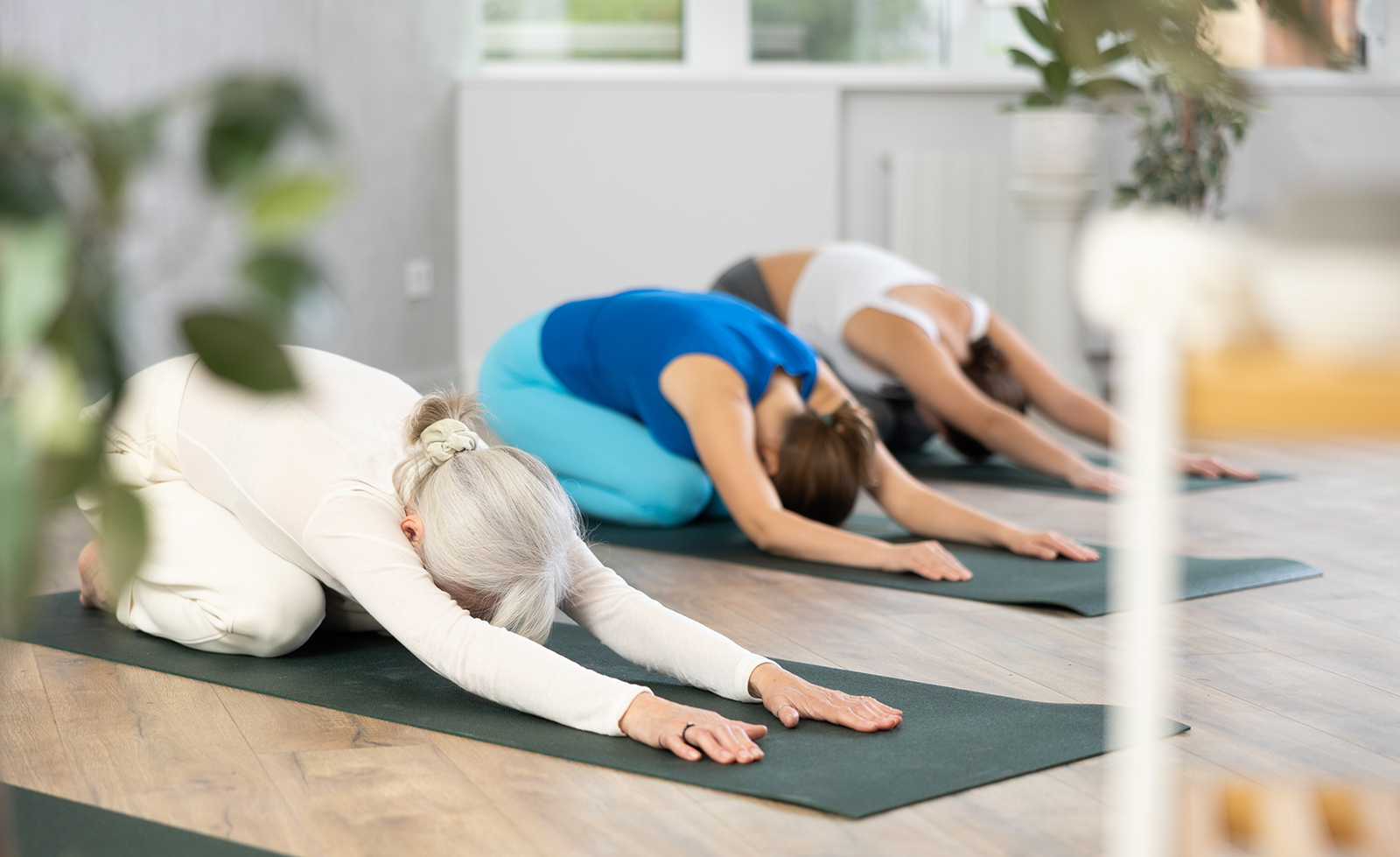
8. Child’s Pose: Kneel and sit on your knees, leaning forward while keeping your butt on your heels. Rest your forehead on the floor, and move your arms so they’re next to your legs behind you, palms facing up. Inhale and exhale, slowly and deeply, holding this position for up to two minutes (or more . . . it’s a relaxing pose that can be held for longer periods).
Pressed for Time? We’ve Got You!
With quick, effective workouts and flexible plans, MPC helps you stay consistent without the overwhelm. Join us and start moving forward—one workout at a time.