


By Katy Loren
What’s the “best” type of cardio?
That question has been debated, scrutinized, and studied for decades, but the answer is actually simple, and quite personal — that is, whatever cardio you enjoy, and that you’ll stick to for the long term, is the optimal choice.
A lot of people have learned that lesson the expensive way, having paid for fancy treadmills that soon morph into clothing racks, or a 12-pack of classes at that spin gym they haven’t been back to for months. In reality, the cardio that you’ll be motivated to do is the one that’ll burn the most calories and improve your cardiovascular system, whether it’s hiking, dancing, stadium stair climbing, swimming, or just walking around your neighborhood.
That said, once you choose an activity (or three) that you’re especially fond of, you can then maximize the benefits of the time spent training by doing a bit of easy math, and then listening to your heart during your sessions.
Related: The One Workout Most of Us Are Missing
Heart Smart
Cardio, of course, can vary widely in intensity. A casual stroll is more leisurely than an all-out sprint, after all. But there’s also some good news in that a variety of intensities can promote health benefits and positive physical adaptations in your body.
To help differentiate and serve as a guide, fitness experts have tapped science to figure out five specific “Heart Rate Zones” that each convey some interesting, distinct benefits based on common exercise goals.
“Zones 1 to 3 are best for weight loss and building aerobic endurance, while Zones 4 to 5 are ideal for improving your speed, power, anaerobic capacity,” explains Gretchen Zelek, owner of Go Gretch in Los Angeles, AFAA-certified group fitness instructor and Functional Aging Specialist.
Here’s more detail on each one:
Zone 1: Getting Ready
Max HR Range: 50%–60%
Best For: Warming up and cooling down. “Think leisurely walk, easy marching in place, even active stretching,” Zelek says.
Zone 2: Grind-It-Out Fat Burning Mode
Max HR Range: 60%–70%
Best For: You’ll reach Zone 2 via steady-state activity, like a moderately-paced 30-to-60–minute endurance cardio session. “This is a brisk walk, jumping jacks, biking without big hills or hard sprints, Pilates, light dance, Barre, or hot yoga,” Zelek suggests.
Zone 3: Pushing Yourself (Gently)
Max HR Range: 70%–80%
Best For: Moderate intensity, steady-state bouts aimed at improving your cardio fitness levels. “Zone 3 is where you’ll be during a rowing session, moderate-paced biking or running, swimming, or Zumba, to name a few options,” Zelek says.
Zone 4: High Intensity
Max HR Range: 80%–90%
Best For: Shorter bursts (like sprints), or high-intensity interval training (HIIT). “Here, you’re doing things like uphill runs, boxing, or an intense indoor cycling class,” notes Zelek.
Zone 5: For Serious Athletes Only
Max HR Range: 90%–100%
Best For: Max all-out anaerobic efforts to improve speed, stamina, and prompt high-level physiological adaptations. “Zone 5 is highest intensity efforts, like short-duration all-out sprints, the highest efforts within a HIIT workout, fast-paced jump rope, a high-knee sprint in place, or very fast mountain climbers.”
If you can work in most or all of those zones at some point each week, that’s great. However, it all depends on your goals: For most of us, sticking mainly within zones 1 to 3 is enough in our regular workouts, with zones 4 to 5 good for occasional bouts of interval training when we’re ready to challenge ourselves.
With this information in hand, you’ll need two things: First, you’ll want to know your own HR Max, so that you can figure out your heart rate that corresponds to each zone. And second, you’ll want a way to measure your current heart rate during exercise quickly.
Related: Why You Need to Do Cardio
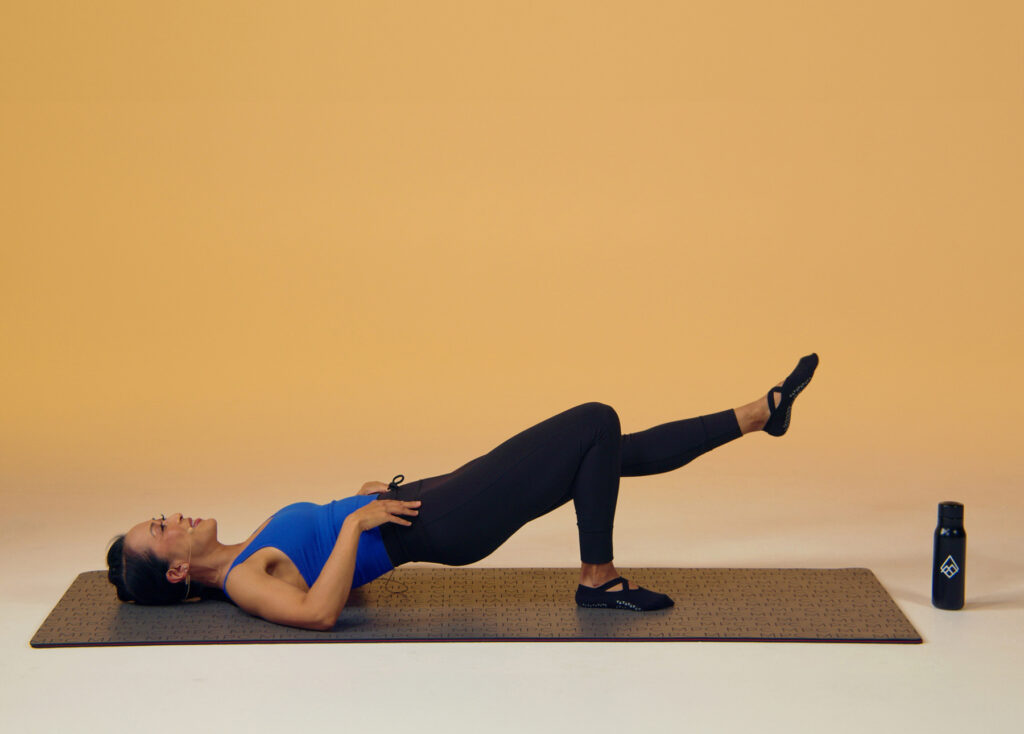
Mat Pilates builds more than core strength — it’s a heart-smart workout. By tracking your heart rate, you can tailor the intensity to your fitness goals.
What’s My HR Max?
The idea of calculating and measuring your heart rate can seem like a daunting math assignment when all you’re trying to do is ride an exercise bike, run on a treadmill, or simply take a walk outside. But thanks to some simple shortcuts, it’s not intimidating or difficult to figure out (and you only have to crunch the numbers once per year). Here are the most common options:
1. Basic Math: To estimate your maximum heart rate (the number of times your heart could potentially beat in one minute at full capacity), you can subtract your age from 220. If you’re 50 years old, 220-50=170 — so your max beats per minute (bpm) is 170.
You then take that and apply it to each zone, like this:
| Zone | HR Max | Beats Per Minute Range for a 50-Year-Old |
|---|---|---|
| 1 | 50%–60% | 85–102 bpm (0.5×170, 0.6×170) |
| 2 | 60%–70% | 102–119 bpm |
| 3 | 70%–80% | 119–136 bpm |
| 4 | 80%–90% | 136–153 bpm |
| 5 | 90%–100% | 153–170 bpm |
Armed with that information, you know where your bpm should fall — for your warm-up activity, you’ll want your heart rate monitor to show you in the range of 85–102. If you’re doing a steady state run, you’ll want your heart rate not to spike higher than about 136 bpm during your session. And if you’re doing sprints or intervals, you’ll want to work hard enough that your bpm goes above 136 (or 153 for more advanced athletes).
2. (Slightly) Advanced Math: Admittedly, the 220 minus your age calculation is very simple. It’s fine for most casual exercisers. But if you want to get a little more precise, there’s another calculation that includes resting heart rate (RHR).
How do you figure out your RHR? Tomorrow morning, after sleeping but before climbing out of bed, measure your heart rate. You can place two fingers on the carotid artery of your neck for 10 seconds and multiply that result by 10, or go 30 seconds and double it, or count out 60 seconds of beats if you prefer. A heart rate monitor (which we discuss in the next section) can do the trick, too.
With your RHR in hand, plus the MHR from your “basic math” above, you’ll be able to figure out your estimated “heart rate reserve” (HRR). That’s essentially the number of beats you have “in reserve” between your resting state and your maximum exercise state. With that, you can better personalize your bpm in the five Training Zones.
Let’s say the 50-year-old in our example has an RHR of 75. To get her HRR, you take the MHR minus the RHR to get HRR — 170-75=95 HRR.
The next step is to multiply HRR by 0.5 and 0.6 to get the range for Zone 1 — 0.5×95=47.5, 0.6×95=57.
Now, you add back your resting heart rate, or RHR to each figure— 47.5+75=122.5, 57+75=132. Thus, the 50-year-old’s personalized Zone 1 range is 122.5-132 bpm. (Or, 123–132 rounded to the nearest whole number.)
Let’s see what that would look like in all the zones:
| Zone | HR Max | Beats Per Minute Range for a 50-year-old |
|---|---|---|
| 1 | 50%–60% | 123–132 bpm |
| 2 | 60%–70% | 132–142 bpm |
| 3 | 70%–80% | 142–151 bpm |
| 4 | 80%–90% | 151–161 bpm |
| 5 | 90%–100% | 161–170 bpm |
Those tighter ranges should be more accurate in landing you in the right heart rate zone.
Talk It Out
Does the idea of math have you clicking as fast as you can away from this article? Wait! Before you go, there’s an alternative — it may not be quite as accurate as the two options above, but it’s a helpful little tool nonetheless. All you need to do is talk (or try to, at least). Zelek suggests self-assessing using a “Rate of Perceived Exertion” (RPE) scale, with each of the five levels below roughly corresponding to the heart rate zones:
| RPE | Your Intensity | Assessment |
|---|---|---|
| 0-3 | Very Light/Light | Easy to breathe, talk, and sing |
| 4-5 | Moderate | Can talk in 3-to-5-word phrases (but not sing) |
| 6-7 | Hard | Breathing harder and faster; challenging |
| 8-9 | Very Hard | Cannot maintain conversation, heavy breathing |
| 8-9 | Maximum | Can only maintain this level for seconds |
How Can I Easily Measure My Exercise Heart Rate?
Earlier in this article, I mentioned all that wasted money spent on cardio, but there is one expenditure worth considering: a heart rate monitor. Some of the most popular brands include Polar, Garmin, Fitbit, and, of course, the Apple Watch.
“My Apple watch alerted me to a heart health problem while I was running,” Zelek recalls. “My heart rate was significantly higher — 215 — than the maximum heart rate for my age, which is 155. Because of my Apple Heart Rate monitor, I essentially discovered that I had developed ventricular tachycardia, which was successfully resolved with surgery.”
Here’s more on three of the most popular options.
Apple Watch
Cost: $399-$799
Top Features: Measures heart rate and heart rate zones (plus provides insights as to how it compares to your typical zones for an activity); tracks intensity and duration of your workouts
Unique Benefit: The Apple Watch is a computer on your wrist.
Whoop
Cost: $199-$359 per year membership fee (which includes the band); offers a one-month free trial
Top Features: Measures heart rate and VO2 max, provides sleep training and recovery insights, and access to personalized coaching
Unique Benefit: This simple band doesn’t have a screen — meaning it doesn’t distract you during your workouts, which can lead to better, more accurate overall measurements.
Oura Ring
Cost: $349-$500
Top Features: Tracks heart rate and VO2 max, provides activity score, measures sleep cycles, gives a cardiovascular age for better insights into your health
Unique Benefit: It’s unobtrusive. With no bulky watch or band, it’s just a regular-sized ring that slips on your finger.
Ready to Put This Into Practice?
At My Peak Challenge, we believe fitness isn’t about perfection — it’s about progress, community, and showing up for yourself every day. Join thousands of Peakers worldwide and get access to full training programs, nutrition resources, and the support of a community that’s cheering you on in every zone.