

We spend a surprising amount of time thinking about what’s wrong. The deadline we missed. The workout we didn’t finish. The conversation that didn’t go as planned. The things we wish we’d done differently.
Meanwhile, the good stuff often slips by unnoticed.
It’s not that we’re ungrateful. Our brains are naturally wired to pay attention to potential problems and threats. That tendency can help keep us safe, but it can also mean that frustrations, worries and disappointments take up more mental space than the things that are going well.
Gratitude offers a way to shift some of that attention.
And no, we’re not talking about pretending everything is wonderful or forcing yourself to find a silver lining when life gets difficult. Gratitude is simply the practice of recognizing and appreciating what’s good, whether that’s a meaningful relationship, something your body allows you to do or a small moment that makes an ordinary day a little better.
Researchers have spent decades studying gratitude and its relationship to psychological and physical health. While it’s not a cure-all, the findings suggest that regularly practicing gratitude may offer some meaningful benefits.
Your Brain on Gratitude
Think about the last time someone did something unexpectedly kind for you. Maybe a friend checked in when you were having a rough week, someone offered encouragement when you needed it or a stranger made your day a little easier.
Chances are, that moment felt good. But why?
Gratitude involves several mental processes, including recognizing something positive, appreciating its value and, often, acknowledging that someone or something outside ourselves contributed to it.
Researchers have used brain imaging to explore what happens when people experience or express gratitude. Some studies have identified activity in areas of the prefrontal cortex involved in social understanding, decision-making and evaluating experiences.
That doesn’t mean gratitude permanently rewires your brain or automatically boosts your feel-good chemicals, as some popular wellness claims suggest. The neuroscience is still developing.
What we do know is that practicing gratitude encourages us to pay attention to experiences we might otherwise overlook. And where we direct our attention can influence how we interpret our lives.
The goal isn’t to ignore what’s difficult. It’s to make sure the difficult things aren’t the only things getting our attention.
Gratitude and Emotional Well-Being: What the Research Shows
One of the strongest areas of gratitude research involves psychological well-being.
A 2025 meta-analysis published in Proceedings of the National Academy of Sciences examined 145 studies involving more than 24,800 participants across 28 countries. Researchers found that gratitude practices, including writing gratitude letters and reflecting on things people appreciated, produced small but measurable improvements in well-being.
The word small matters here. Gratitude didn’t transform people’s lives overnight, and the benefits varied between studies and countries. But the overall findings suggest that intentionally practicing gratitude can help people experience more positive emotions and greater well-being.
There’s also evidence that gratitude may help reduce psychological distress. A 2023 systematic review and meta-analysis of 64 randomized trials found that gratitude interventions were associated with improvements in mental health and reductions in symptoms of anxiety and depression, although the certainty of some findings was limited.
That doesn’t make gratitude a treatment for depression or anxiety. But it may be one useful practice alongside other strategies that support mental health.
And importantly, you don’t have to feel grateful every minute of the day to benefit.
Can Gratitude Help You Sleep Better?
If you’ve ever climbed into bed only to find yourself replaying everything that went wrong during the day, you know how difficult it can be to quiet a busy mind.
Some research suggests that gratitude may help.
A systematic review published in the Journal of Psychosomatic Research examined 19 randomized studies of gratitude interventions and physical health. Of the eight studies that assessed subjective sleep quality, five reported improvements.
Another randomized study involving 119 women found that a two-week gratitude practice improved self-reported sleep quality and optimism compared with control conditions.
Researchers are still working to understand why. One possibility is that reflecting on positive experiences before bed helps redirect attention away from worries and unfinished business.
The evidence isn’t strong enough to suggest gratitude can treat insomnia or replace good sleep habits. But spending a minute or two recalling something good about your day may be a worthwhile addition to your evening routine.
Gratitude Can Strengthen Our Connections
Some of the most compelling research on gratitude has less to do with how we feel about ourselves and more to do with how we relate to others.
Think about the difference between appreciating a friend and actually telling them how much their support means to you.
Both matter, but expressing gratitude can turn a private feeling into a moment of connection.
Psychologist Sara Algoe and colleagues have studied how gratitude functions in relationships. Their research suggests that gratitude helps us recognize people who are responsive to our needs and may contribute to stronger social bonds.
In a study published in Emotion, researchers explored how expressing gratitude influences relationships, supporting the idea that gratitude serves an important social function.
It’s something we see every day in the Peaker community.
A supportive comment after a tough workout. A message from someone checking in. A fellow Peaker celebrating your progress.
These gestures might seem small, but they remind us that we don’t have to do everything alone.
And sometimes the simplest way to strengthen a connection is to tell someone, “I appreciate you.”
What About Physical Health?
You’ve probably seen headlines suggesting gratitude can lower blood pressure, reduce inflammation, improve immunity or even help you live longer.
The reality is more complicated.
Some studies have found promising associations between gratitude practices and physical health measures. For example, the small randomized study of 119 women mentioned earlier also reported improvements in diastolic blood pressure after two weeks of gratitude practice.
But broader reviews have found that evidence for physical health benefits remains limited and inconsistent. In the 19-study review, researchers identified possible benefits for sleep, while findings involving inflammation, blood pressure and other physical health outcomes were too sparse to support firm conclusions.
In other words, gratitude may support aspects of health and well-being, but it isn’t a substitute for exercise, nutritious food, adequate sleep or appropriate medical care.
Think of it as another tool in your well-being toolkit, not a replacement for the habits that keep you healthy.
Gratitude Isn’t Toxic Positivity
There’s one important distinction worth making before you start a gratitude practice.
Being grateful doesn’t mean you have to be happy about everything.
You can appreciate your body while feeling frustrated by an injury. You can be thankful for your family while feeling overwhelmed by your responsibilities. You can recognize the good in your life while navigating grief, stress, uncertainty or loss.
Those feelings aren’t mutually exclusive.
In fact, one reason gratitude practices may be helpful is that they encourage us to recognize positive experiences alongside the difficult ones, rather than insisting that the difficult experiences don’t exist.
And there will be days when gratitude feels harder to access. That’s normal, too.
The goal isn’t to force a positive attitude or turn every challenge into a lesson. It’s to become more aware of the moments, people and experiences that bring value to our lives.
Sometimes that’s something significant. Other times, it’s a good cup of coffee, a walk in the sunshine or a friend who makes you laugh.
Both count.
Related: Insight Gratitude Practice
Small Moments, Meaningful Habits
If there’s one takeaway from the research, it’s that gratitude doesn’t need to be complicated.
Most gratitude studies have examined relatively simple activities: reflecting on positive experiences, listing things people appreciate, writing thank-you letters or expressing appreciation to others.
You don’t need special equipment, an elaborate routine or even a journal.
You can practice gratitude while walking the dog, finishing a workout, preparing dinner or talking with a friend.
And you don’t have to do it perfectly. The research doesn’t establish a single ideal frequency or method that works for everyone.
What matters is finding an approach that feels meaningful and fits into your life.
That’s the idea behind our November challenge.
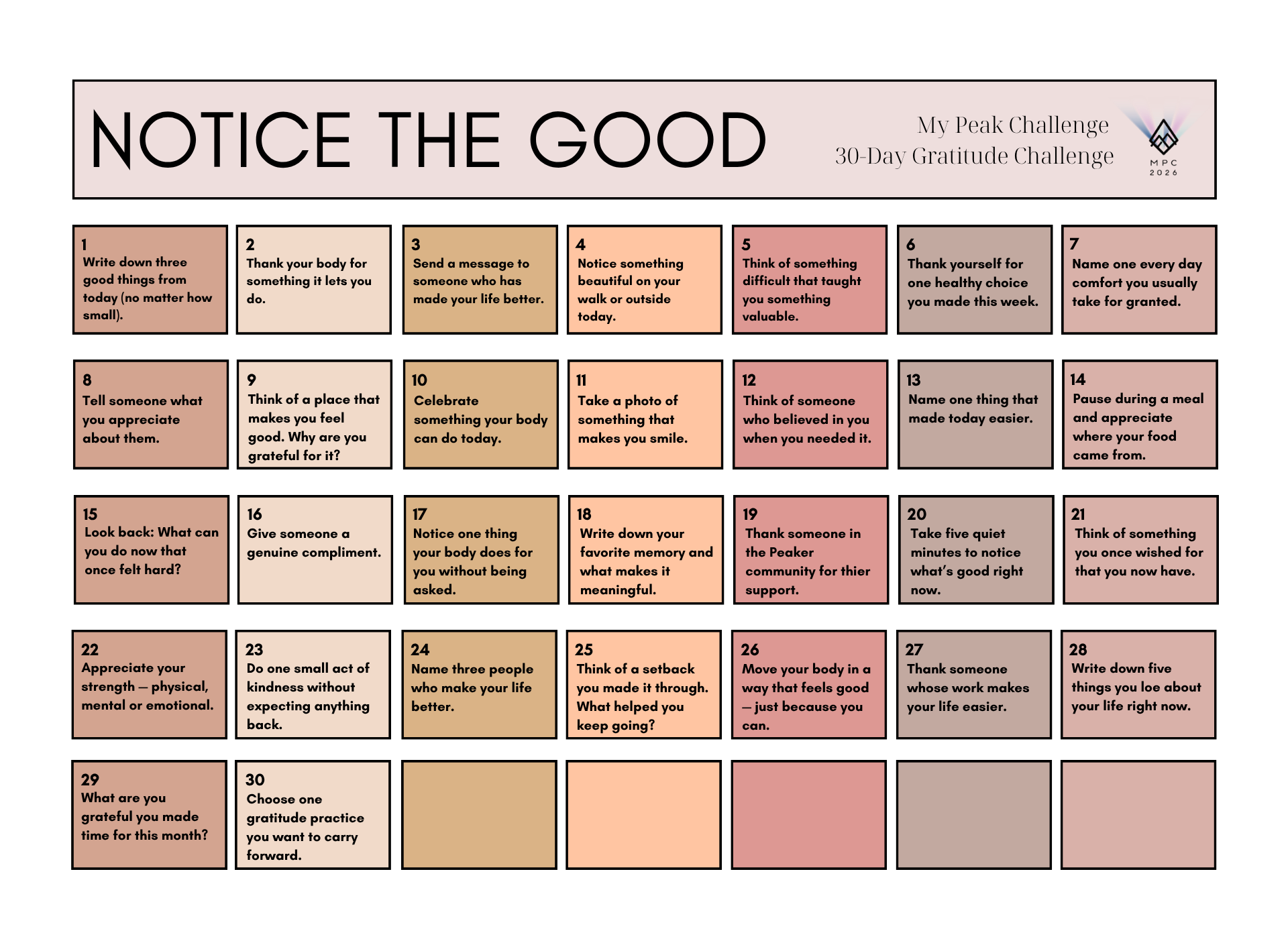
Notice the Good: Join Our 30-Day Gratitude Challenge
Gratitude doesn’t mean pretending everything is perfect. It’s about taking a moment to recognize what’s good, even when life feels busy, stressful or uncertain.
This November, we’re inviting you to join Notice the Good, a 30-day gratitude challenge designed to help you appreciate the little things, celebrate your progress and strengthen your connections with the people around you.
Each day on the calendar offers one simple prompt to help you pause and shift your perspective. Some encourage reflection, while others invite you to move, connect with someone or simply pay attention to something you might otherwise overlook.
There’s no right or wrong way to participate, and you don’t need to set aside a lot of time. Just a few intentional minutes each day can help you practice noticing and appreciating the good in your life.
Download the calendar, start wherever you are and join us for 30 days of gratitude. And if a prompt resonates with you, share your thoughts with the Peaker community. You never know who might need that little reminder to notice the good, too.