
By Katy Loren
Some days, your workout feels like… a lot.
Maybe you’re sore and the barbell feels like too much. Maybe the free weight area isn’t calling your name today. Or maybe—no offense to crunches—you just can’t stomach doing another one. (Pun intended. Sorry, not sorry.)
But skipping your workout altogether? Not the move. Sometimes you just need a gentler option that still delivers results. That’s where smart, low-impact swaps come in.
Here are five simple substitutions you can make to ease the intensity without sacrificing the benefits. Because sometimes the “hard” in “hardcore” needs a little softening.
1. Swap out the squats.
Not a fan of heavy-duty barbell squats? You’re in good company. They’re incredibly effective—but also one of the most demanding moves out there. And even switching to a dumbbell or Smith machine version doesn’t always make them feel more approachable.
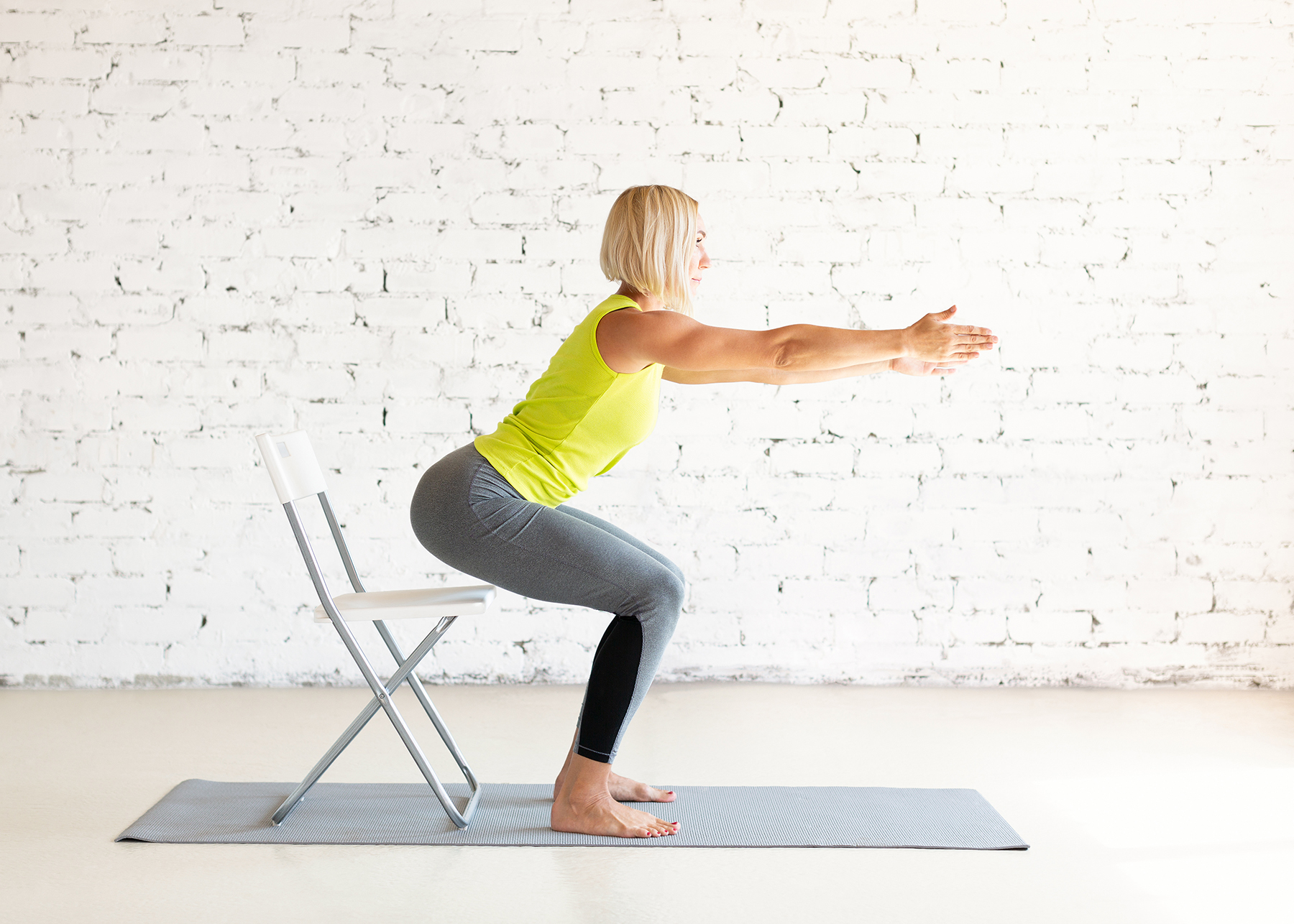
While squats are often hyped as a non-negotiable, the truth is they’re not a perfect fit for everyone. Whether you’re dealing with mobility issues, recovering from injury, or just not vibing with squats today, you’ve got options. These alternative moves still mimic the essential “sit-to-stand” action at the core of the squat—without making you dread leg day.
Bodyweight Box Squat: This move is like sitting down in a chair and getting back up, but without having to manage a barbell draped across your shoulders.
Single-Leg Box Squat: If you have one noticeably stronger leg (which isn’t uncommon at all), you’ll want to work on evening out that imbalance over time with unilateral exercises. Here, you stand and sit using one leg at a time; if you’re struggling, recruit a partner to stand in front of you, holding your hands to assist as you learn the motion and develop the strength to do it yourself.
Related: Step Up For Strength
2. Modify your lunges for better knee support.
Are lunges a wonderful alternative to squats? Absolutely. That they mimic a walking motion makes them extremely functional to boot.
However, they’re also not the easiest movement to master, requiring ample balance, agility, flexibility, and joint mobility as you transition from standing to a deep step forward, sideways, or backward, depending on your chosen flavor of lunge in that moment.
If you find yourself struggling your way through a regular lunge, you may want to try either (a) a supported variation, where you incorporate a handhold of a sturdy object to help you through the hardest portions of the lunge, or (b) a simpler leg exercise that hones your ability to balance on one leg at a time. Here are two examples that will help build up your strength and confidence to tackle the real thing in no time.
Assisted Split Squat: If balance is an issue you struggle with on standing leg exercises, this one is a nice starter — you do lunges alongside a flat bench, and use one hand to steady yourself at the bottom of each rep.
PVC Pipe Single-Leg Deadlift: This is a solid glute builder, which is a prime mover for the lunge. If you don’t have a section of PVC pipe handy, you can swap it out for any sort of stick — anything from a yoga bamboo stick to a broom handle.
3. Drop the iron.
If pumping iron has your muscles and joints feeling more achy than awesome, it may be time to back off the free weights to give your body a break. That doesn’t mean foregoing your workouts, but instead making a few swaps.
Here’s a fitness secret: Any exercise that can be done with a barbell or dumbbell can be simulated with resistance bands. These are basically the “rubber bands” you’ve likely seen at the gym or studio — some have handles built in, while others are closed loops, but all provide various levels of resistance similar to a dumbbell, barbell, or machine, but without the metal heft.
You can use them for a whole workout, or just for a few movements within your regular training session. The added bonus: Unlike dumbbells or barbells, a band can provide constant tension throughout the range of motion — and increase the challenge at the top of each repetition — giving your muscles a new stimulus if you’ve tended to be free-weight-centric in the past. For a test run, consider one or both of the following sample swap-outs.
Banded Biceps Curl and Hold: This is a perfect example of an exercise, often done with a barbell or dumbbells, that can be re-created with a band. Here, you can add a “hold” at the top for an extra biceps squeeze, which is improved upon with the band because of the increasing tension as you reach the top of the curl.
Banded Chest Press: With free weights, you need to be in a lying position to engage your chest — but if you have a band handy, it’s no bench, no problem, as you can perform chest presses standing up. The linked video shows you how.
Band Pull-Through: This exercise resembles the stiff-legged deadlift for the hamstrings and glutes, and it also targets areas similarly to the kettlebell swing, but with full control through the positive and eccentric (up and down) portions of the lift.
Related: The Benefit of Adding Resistance Bands to Your Workout
4. Kibosh the crunch.
Want some abdominal definition without endless crunches? If you still have those resistance bands handy from #3, you’re in luck, because they can help give you a solid all-around ab workout without even needing to lie down.
Banded Pallof Press: This exercise involves holding onto bands anchored to a sturdy object and slowly twisting your upper body, which engages the upper abs, lower abs, and obliques (those muscles that lie alongside the “six-pack” muscles in the center).
Banded Overhead Hold: This may not seem like an obvious ab exercise, because you’ll be feeling all sorts of other upper-body muscles as you do it, but make no mistake: Your core will be key to doing it right. And like the Pallof Press, you’ll do it without sitting or lying down.
5. Trade out the treadmill.
Treadmills are the most popular piece of cardio equipment in the gym… but arguably the most monotonous, as well, meaning they can provide a “fast track” to burnout if you’re not careful. If you’re a dedicated runner training for a race, you may need to stick it out, but if your goals are more about general heart health and fat burning, you’ll benefit from some aerobic alternatives. Here are three you can learn more about right here on the My Peak Challenge website.
Boxing: According to calculations from Harvard Medical School, 30 minutes of sparring can help a 155-pound person burn 324 calories, which is more than the 288 that same individual uses up running at a 12-minute-mile pace for a half hour. A boxing workout is on par with a jog or a run, and gives you an interesting change of pace to boot. Check out our available classes by clicking here.
Pilates: Created in the early 1900s by German trainer Joseph Pilates, this training system is built around exercises that focus on what he considered the “five essentials” — breathing, scapular stabilization, cervical alignment, engagement of the transversus abdominis, and pelvic mobility. While a Pilates studio would include a “Reformer” machine, you can get much of the same benefits with nothing more than a mat, as demonstrated in our Beginner Pilates video course.
Capacity Cardio: It’s not exactly pure cardio like a treadmill run, but our Capacity Cardio program — a powerful resistance training/aerobic exercise hybrid — will get your heart rate up, improve your VO2 max, and burn plenty of calories. The “secret” is circuit-style programming, where you’ll perform a variety of movements back-to-back, with selections ranging from 15-minute to 40-minute workouts, allowing you to choose based on your personal fitness level and time limitations. You can view the introductory video by clicking here, and find the list of courses here.
Train Smarter, Not Harder
Join My Peak Challenge and get access to expert-led workouts, smart modifications, and a supportive community that meets you where you are.