

By Shoshana Pritzker RD, CDN, CISSN, LDN
You’re already motivated and ready to take charge of your goals. While structured programs offer a great starting point, it’s time to level up your self-reliance. Imagine the power of designing a plan that perfectly fits your unique preferences, lifestyle, and background. Wouldn’t it be amazing to become your own expert, crafting a path that truly resonates with you?
My Peak Challenge’s meal plans are based on specific macronutrient ratios. Your ideal macronutrient ratio depends entirely on your goals – whether it’s maintaining your current fitness, building muscle, or boosting performance. The dilemma with many pre-existing plans is that they’re one-size-fits-all, not tailored to your specific needs.
Now is the perfect time to create your own meal plan or tweak the ones provided using simple macronutrient equations. Here’s what you need to know.
Related: What Happens When You Don’t Eat Enough
What Are Macros?
Macronutrients—protein, carbohydrates, and dietary fat—make up the calories we eat. Each macronutrient has a specific number of calories per gram. You’ll use these numbers to find how many calories you need from each macronutrient food group.
• 1 gram of protein = 4 calories
• 1 gram of carbohydrates = 4 calories
• 1 gram of fat = 9 calories
While you’ll need to figure out your daily calorie intake to calculate your macros, your daily focus will not be on calories. Instead, you’ll break up the totals of each macronutrient between meals and snacks throughout the day.
Protein
Once you figure out how many grams of protein you need for the day, you can fill your day with protein-rich foods that include the following:
• Chicken
• Turkey
• Eggs and egg whites
• Meat
• Pork
• Fish and shellfish
• Tofu and tempeh
• Cottage cheese, yogurt and Greek yogurt
• Protein powder and shakes
Carbohydrates
When it comes to carbs, we’re talking about anything starchy and fruit. Think whole grains, potatoes, rice, and the like. Here’s a basic list of foods for the carb group.
• Bread, bagels, wraps and English muffins
• Cereal, oatmeal and granola
• Chips and crackers
• Muffins and baked goods
• Rice and brown rice
• Pasta
• Potatoes and sweet potatoes
• Quinoa
• Fruit
While vegetables have carbohydrates, they’re mostly fibrous, so they’re not digested the same. For more on that, you can watch Facts About Fiber.
Dietary Fat
Dietary fat is primarily found in the following foods:
• Olive oil, canola oil, avocado oil, and other healthy oils
• Cheese
• Low-fat dairy
• Nuts and seeds
• Nut and seed butters
• Flaxseed
• Fish and fish oil
How to Calculate Your Macros
First, figure out your daily calorie needs. You can use an online calorie calculator tool or plug your stats into the equations below.
For Women
BMR = 10 × weight (in kilograms) + 6.25 × height (in centimeters) – 5 × age (in years) – 161
For Men:
BMR = 10 × weight (in kilograms) + 6.25 × height (in centimeters) – 5 × age (in years) + 5
To find your weight in kilograms (kg), multiply your bodyweight by 2.2.
To find your height in centimeters (cm), multiply your height in inches by 2.54.
Your BMR (basal metabolic rate) only tells you how many calories your body needs to exist and carry out activities of daily living. Once you’ve found your basic calorie needs, you’ll want to factor in your activity level.
For example, a 54-year-old, 105-pound, 5-foot-tall woman would have a BMR of 1,163 calories per day.
Use this table to find your total calorie needs based on your activity level.
Sedentary (little to no exercise): BMR x 1.2
Lightly active (exercise 1-3 days/week): BMR x 1.375
Moderately active (exercise 3-5 days/week): BMR x 1.55
Active (exercise 6-7 days/week): BMR x 1.725
Very active (hard exercise 6-7 days/week): BMR x 19
Now that you have your total calorie needs, you’ll use this number to calculate the amount of protein, carbohydrates and dietary fat you need each day based on your goals.
Many MPC meal plans are based on a general ratio consisting of 40/30/30 — or 40 percent protein, 30 percent carbohydrates, and 30 percent dietary fat.
However, it’s understandable that not every Peaker’s goals are the same. Read on to calculate your macros for building muscle or boosting performance.
How to Calculate Macros to Build Muscle
Building muscle and gaining strength require two things: calories and protein. For this reason, the macro ratios will be heavy on protein while keeping carbohydrates and dietary fat moderate.
Unfortunately, you can’t just fill your day with loads of protein and nothing else. For one, it’s difficult to eat an extravagant quantity of protein in one day. Second, carbs and fats provide your body’s nutrients to fuel workouts, recover efficiently, and absorb essential vitamins and minerals.
Here are the ratios for building muscle: 35 percent protein, 35 percent carbohydrates, and 30 percent dietary fat.
How to Calculate Macros to Boost Performance
Getting faster and more efficient requires a lot of energy. Luckily, the body loves using carbohydrates to fuel endurance activities. To exercise longer and harder, you’ll need plenty of carbs, a moderate amount of protein, and less fat.
Here are the ratios for boosting performance: 30 percent protein, 50 percent carbohydrates, and 20 percent dietary fat.
Putting Macros Into Practice
Now, use your daily calorie needs to find the grams of each macronutrient you’ll need for the day.
Here’s how your macronutrient breakdown looks if you are eating according to an 1,800-calorie diet to boost performance:
Protein = .30 x 1800 = 540 calories divided by 4 = 135 grams of protein per day
Carbs = .50 x 1800 = 900 calories divided by 4 = 225 grams of carbs per day
Fat = .20 x 1800 = 360 calories divided by 9 = 40 grams of fat per day
You don’t have to log everything you eat to be successful. Instead, try creating a tentative meal plan for yourself according to your macronutrient breakdown. Decide whether you want to eat three meals and one snack daily or three meals and two snacks, etc. Only you know what will work best for you, but a good rule of thumb is not to allow more than three to four hours between meals and snacks. Once you know your meal schedule, allot each meal as part of your protein allowance, carbs, and fat. Finish it up by filling in the snacks.
Remember, nothing is set in stone. These can change and be adjusted as you develop your plan.
Here’s an example of what your performance-boosting plan may look like:
Breakfast: 35 grams of protein + 50 grams of carbs + 10 grams of fat
Snack: 10 grams of protein + 50 grams of carbs
Lunch: 35 grams of protein + 50 grams of carbs + 10 grams of fat
Snack: 20 grams of protein + 25 grams of carbs + 10 grams of fat
Dinner: 35 grams of protein + 50 grams of carbs + 10 grams of fat
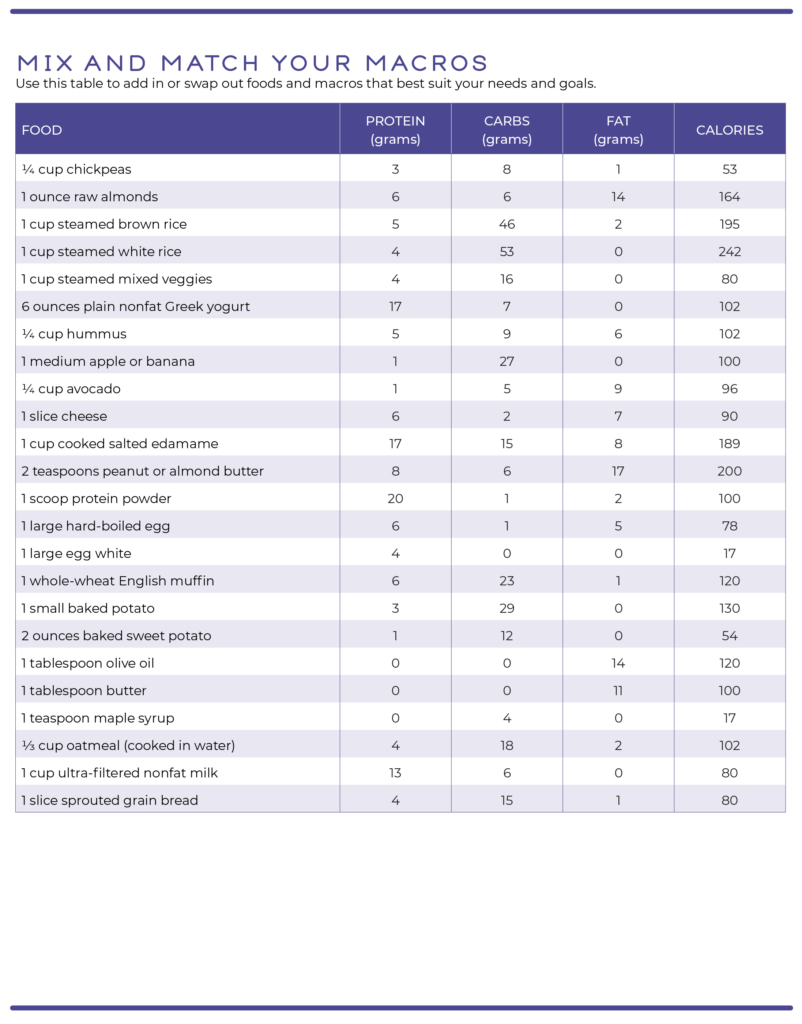
If you decide to use one of the MPC goal-specific meal plans but need more or fewer calories per day — these plans were based on a 2,000-calorie diet — adjust up or down where necessary. Or, if you don’t like all the meals in the plan, you can build some of your own or make equivalent swaps by knowing your macros.
Calculating your macros will help you understand your body’s needs with your goals in mind. That way, you can focus on nourishing your body to be better all around. You got this, Peakers!
Related: Meal Planning Made Easy
Macro Cheat Sheet