
By Katy Loren
“Drop and give me 20! . . . Or, um, okay, how about 10? Maybe 5?”
Drill sergeants aren’t usually that accommodating, of course, but they would probably need to be if issuing that command to the average person on the street. According to a 2021 survey by Gymless.org, more than one-half of respondents admitted they couldn’t get half of that, with 10 being their upper limit; a third said even doing five push-ups would be tough.
Unless you’re a soldier, though, there’s no shame in admitting you’re not so great at push-ups. After all, it’s not something most of us do every day. On the other hand, though, wouldn’t it be great if you could get 20 or more on command?
The push-up isn’t just a punishment, after all. It’s a beneficial exercise for those from all walks of life — it builds strength and muscular endurance in your chest and arms while also engaging your all-important core as you work to keep your body flat and rigid during each repetition.
And learning how to do them well isn’t an impossible task. In reality, over just a few weeks to a couple of months, you could advance from absolute beginner (that is, struggling to get even one proper push-up) to someone who can pump out 10, 20, or more while barely breaking a sweat.
The secret? A progression plan where you slowly and steadily work through five supporting movements that strengthen and prepare your body to handle the challenge. Here’s how to tackle your push-up goals, step by step.
How to Do a Proper Push-Up
To know where we’re heading, it helps to know what, exactly, a “perfect” push-up looks like. Here’s your four-step plan of attack:
1) Assume a “full plank” position: With your feet together, toes pointed and on the ground, you’ll place your hands open and flat on the floor so that your palms align directly with your elbows and shoulders. Your elbows should be extended but not locked or hyperextended, and your body should form a straight line from your heels to the top of your head.
2) Keeping your head in that same plane as your body and your core tight so that your hips don’t collapse downward, lower yourself by bending your elbows until your chest is either within an inch or two of the floor or, ideally, gently touches down.
3) After a one-count, press through your palms until your elbows are straight once again.
4) As for breathing, you can take a deep breath at the top of each rep, hold it as you lower yourself down, and blow out forcefully as you raise your body back to the arms-extended position. Or, if you find that pattern to be a struggle, simply breathe normally as you perform your reps.
Break it Down
The following three holds and two exercises are all designed to make you better at one or more aspects of a regular push-up. They can be added to your regular training routine — beginners should start with 1 to 2 choices from the first group, and then “graduate” to the second group by adding one or both of those exercises once you feel ready.
To get your baseline, at the start of your week and at the beginning of your workout (when you’re fresh), see how many regular push-ups you can do — and there’s no wrong answer because, at the start of each week, you’ll re-test yourself. Maybe on Week 1, it’s just one push-up. By the start of Week 2, you may double that. By Week 3, you may surprise yourself with five. Just keep at it until you reach your personal goal.
Group No. 1: Hold Steady
Full Plank
• A “full plank” is essentially the top position of a push-up. (See “How to Do a Proper Push-Up,” Step 1, above.)
• The plank is all about holding your body in place, making sure your hips don’t drop toward the floor and your body remains straight from your heels through your legs and back to your head for a certain amount of time. Aim for a count of five seconds to start, and build that up as you try for longer holds each successive workout. Seasoned plankers tend to go for holds of 1–2 minutes on average, aiming for sets of 3-5 holds per workout.
Elbow Plank
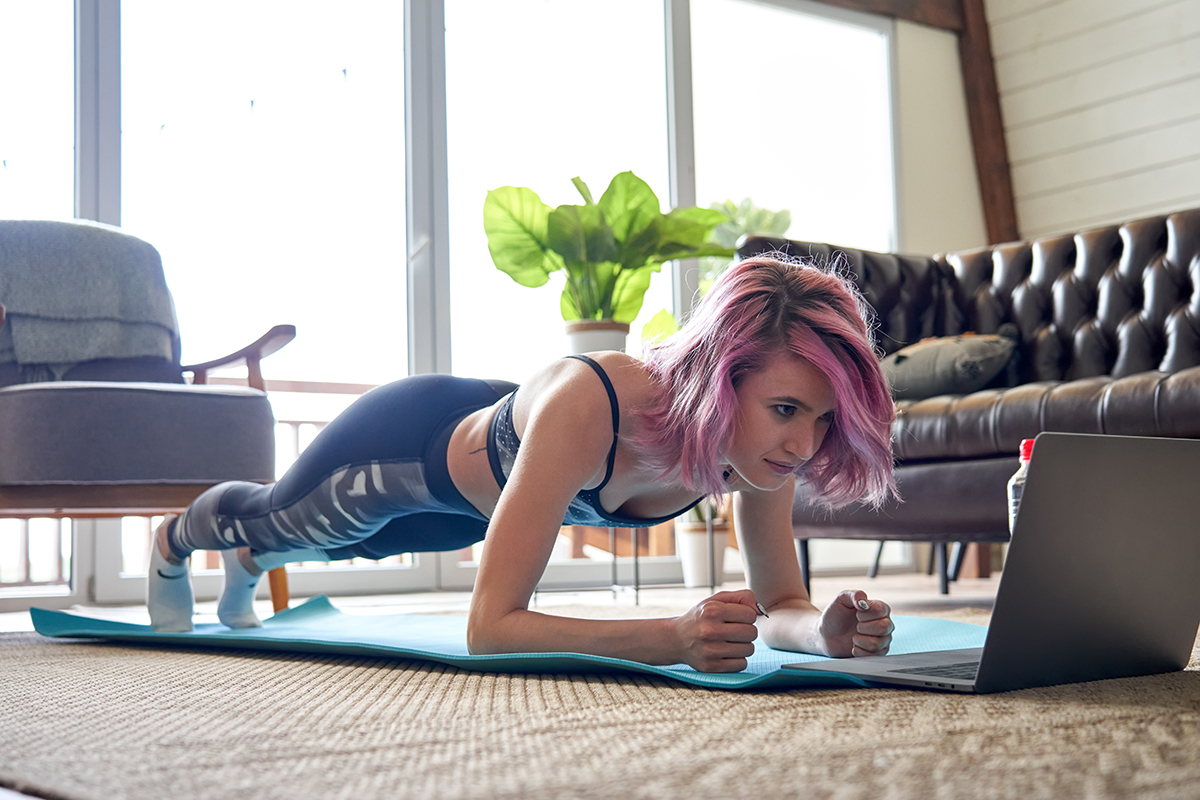
• Get into a modified push-up position, balancing your body on your forearms and your toes, with your body in a straight line from head to feet.
• As with the full plank, you then simply hold this position, flexing your core to keep your hips from collapsing to the floor.
• Start by trying for 5-second holds, then expand on that over time as you get more proficient. Aim for 2–5 sets in all.
Learn More: Forearm Plank
Mid-Position Hold
• Start in the full plank position.
• Next, lower yourself as if you were doing a push-up, but stop halfway down — that’s where you’ll perform your holds, starting with a 5-second hold. Again, aim for 2–5 sets in all.
• If this movement proves to be challenging, put your knees on the floor to make it easier.
Group No. 2: On Bended Knee
Incline Knee Push-Up
• Get on your knees facing the side of a flat bench or step.
• Lean forward so your body is about a 45-degree angle to the floor as you place your hands on the bench and straighten your arms — your shoulders, elbows, and palms should be aligned to start.
• Keeping your knees and toes on the floor, and legs together, bend both elbows to lower your body toward the bench/step. Bring your chest as close as possible, ideally to within an inch or even lightly touching the edge.
• Flex through your chest, shoulders, and triceps to return to the starting, arms-fully-extended position — your elbows should be straight but not locked out or hyperextended.
• Pause for a brief one-count at the top, then begin the next repetition.
• Do three sets of five reps if you’re a beginner, and up to 10 if you’re strong enough. If you can hit 20 reps per set without exerting a lot of effort, you’re ready to graduate to traditional incline push-ups with your legs straight and your body in a plank position.
Assisted Negative Push-Up
• Assume a full plank push-up position — body straight from heel to head, arms extended, toes on the floor.
• Lower yourself toward the floor, taking a five-second count to do so.
• Once your body comes fully down to the floor, bend your knees slightly to put them on the ground.
• With your knees remaining on the floor to assist your movement and make it easier, perform a push-up to return to the starting position.
• Beginners can aim for 1–5 reps, and over time work your way up to 15–20, at which point you will have gained lots of new strength to tackle regular push-ups.
Learn More: Elevated Push-Up