
By Katy Loren
When most of us think of “working out,” we picture movement: running, lifting, cycling, or flowing through yoga poses. The rule seems simple: to get stronger, faster, or more agile, you have to move.
Or do you?
There’s a form of exercise that breaks the rule entirely, one that delivers impressive strength and stability gains without a single rep or step. It’s called isometric training, and it challenges you to push your limits by not moving a muscle.
Related: Join the Resistance
Static King
Isometric training refers to contracting your muscles and holding steady without moving the associated joint. It’s the opposite of the more common type of training, isotonic, where the joints move and muscles contract and extend.
For a simple comparison, think of a push-up versus a plank. The push-up is isotonic, as you’re moving at the elbow and shoulder joints to press your torso up and then lower it back down. The plank, on the other hand, is isometric because you hold a position for a set amount of time, working your abdominals and core to keep your back flat and your body aligned from head to heels.
Exercise scientists have been exploring the benefits of isometric training for decades, and have come up with a lot of evidence as to its effectiveness:
• As reported in a 2001 Journal of Applied Physiology article, French researchers measured muscle response to a standard knee extension versus holding the resistance at a fixed point, finding that isometric training recruited 95% of the total motor units in the working muscle, compared to 88% during the isotonic movement.
• Another study, this one from 2007 and reported in The Journal of Applied Research, found that a group of exercisers who did just seven minutes of isometric contractions daily for a month gained 20% more strength than a control group.
• There’s also evidence that isometric training doesn’t merely improve muscle activation at the exact joint angle that’s used, but translates to benefits beyond that. A 2019 study published in The European Journal of Applied Physiology followed a group that performed 14 isometric-based sessions (again using a knee extension machine) over four weeks at a 65-degree knee angle. “Maximum voluntary torque” — a measure of strength — increased 12, but also improved 7% at 80 degrees, 11% at 50 degrees, and 5% at 35 degrees.
• Isometrics aren’t just about strength and muscle gains, either. Authors of a 2014 “meta-analysis” of various studies, published in Mayo Clinic Proceedings, said that isometric resistance training was shown to lower systolic and diastolic blood pressure. The “magnitude of effect … is larger than that previously reported in dynamic aerobic or resistance training,” they wrote.
Resistance Is (Not) Futile
The best way to try isometrics is to include some holds within the scope of your regular workouts. For instance, let’s say you’re doing a back workout that includes seated cable rows. At the end of each set, stop midway through your final rep with the handles at your abdomen, engage your working muscles to pause in that position for a 10-count, then slowly release until the stack touches down.
You can also incorporate holds into your bodyweight-only moves, such as stopping halfway down during a pull-up, or with your elbows at 45 degrees going down into a push-up.
Those examples aside, however, there is one particularly great piece of equipment for performing isometric holds — a resistance band. That’s because a band provides resistance that gets more intense as you pull it taut, as compared to, say, a dumbbell or barbell, in which the tension on the working muscle lessens at the top and bottom of a rep.
Here’s a quick rundown of seven isometric holds you can do with a band. They can be performed between sets or exercises in a standard weight session, or used as a “finisher” at the end. Another option is to perform each of these together as a stand-alone circuit routine, spending a minute on each, holding for 30 seconds, and then resting for 30 seconds as you move into position for the next in the series.
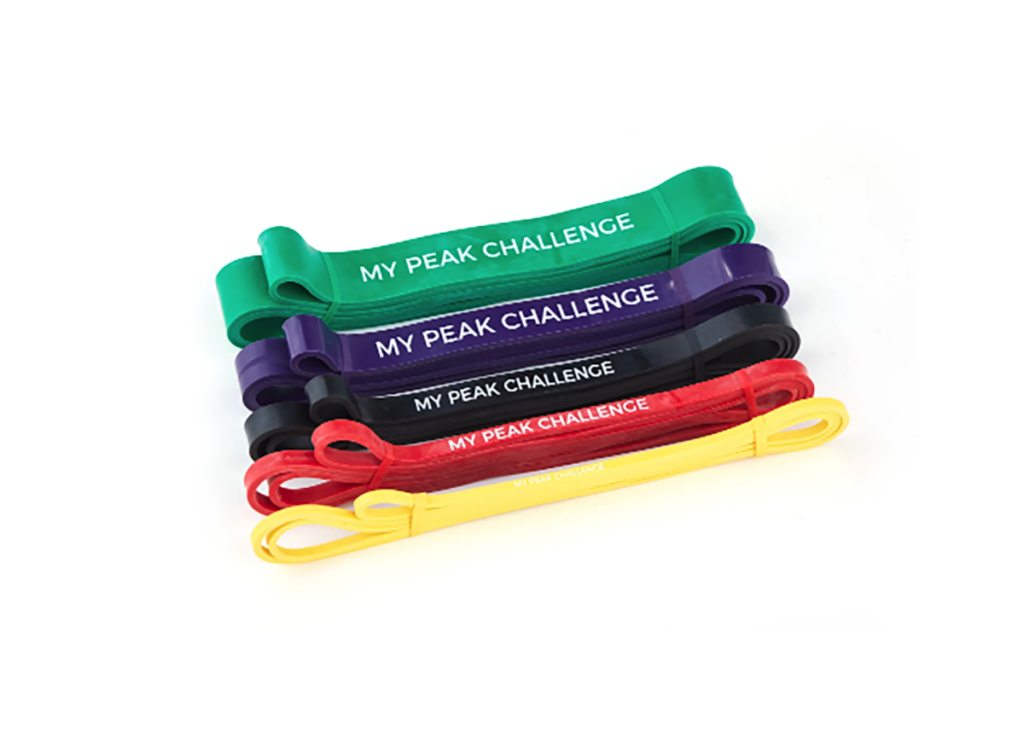
Take your isometric holds to the next level with MPC Resistance Bands. With five levels of resistance, they’re perfect for warm-ups and mobility work, to strength training and pull-up assists.
7 Isometric Band Holds to Build Strength and Stability
1. Banded Squat Hold: Put a closed-loop band so that it’s around both thighs at just above knee level. Keeping your head up, back flat, and core tight, lower yourself into a squat, pressing your legs outward against the band while holding the thigh-parallel position.
2. Standing Pull Hold: Wrap a band around a fixed object such as a pillar or fixed part of a heavy machine or power rack. Grasp each end of the band in one hand, lift your elbows to the same level as your shoulders. Bring your shoulder blades together and bend your elbows, keeping them elevated as you bring your hands to each side of your chest. Hold that contraction, then slowly release.
3. Lateral Shoulder Hold: Step with both feet on a long band with handles on each end. Keeping your body upright, core tight, palms down, and eyes focused forward, lift both arms out to your sides until they’re parallel with the floor. Maintain that position for 30 seconds.
4. Standing Chest Press Hold: Loop a band around a fixed object and face away from it, one end (or handle) in each hand. Step away so that the band is somewhat stretched. Take a staggered stance for stability, lean slightly forward, and keeping your upper body flexed and aligned from head to tailbone, press your arms out directly in front of you until your arms are almost (but not fully) extended. Hold that position for 30 seconds, then slowly release. (You can also hold the position at the halfway point of the press instead of pressing fully forward if you prefer.)
5. Woodchop Hold: Secure a band around a pillar or machine at shoulder level. Hold the ends in both hands and keep them together, arms extended out in front of you at a point parallel to the floor. Rotate sideways to the right and away from the anchor point as far as you can, using your core and abdominal strength to do so, while keeping your body upright. Hold for 30 seconds, then switch sides and repeat by turning to the left.
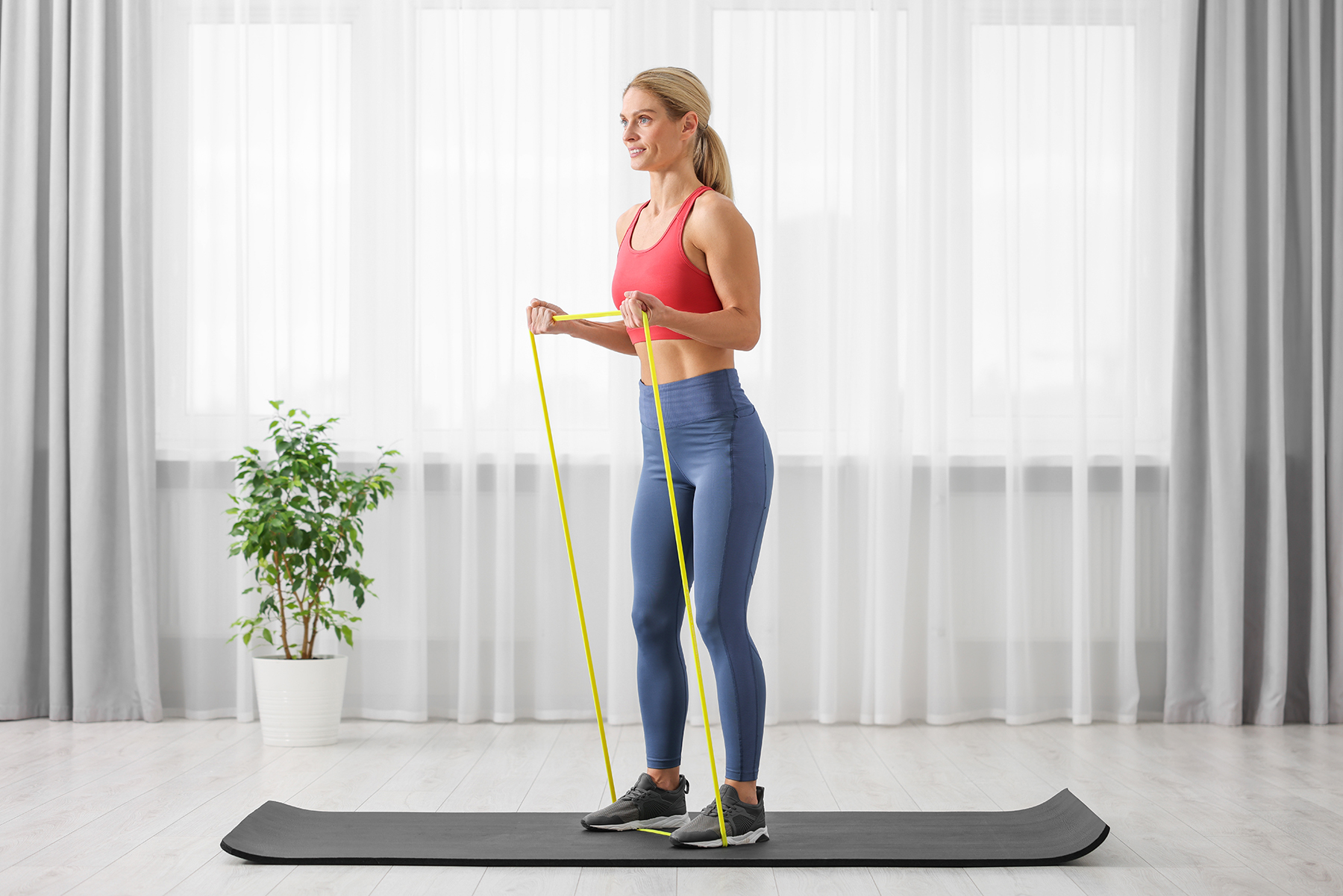
6. Biceps Curl Hold: In a standing position, loop a band underneath both feet and grasp the ends in each hand, arms at your sides. Curl both elbows simultaneously to bend them as far as you can against the resistance, bringing your fists toward your shoulders. Hold the peak contracted position for 30 seconds.
7. Seated Calf Extension Hold: Sit on the floor with your legs out in front of you, knees together, band wrapped around the ball of your feet. Reach forward and grab the band in both hands, then lean back so that your torso and legs form a 90-degree angle. Shift your elbows behind you to make the band taut, then push your toes forward to extend your feet as much as you can against the band. Hold that position for 30 seconds.
Stronger Together
Starts Here
Discover what’s possible when you train with purpose and a community that’s got your back. Join My Peak Challenge and find your strength—in movement, in mindset, and in connection.